Dunning Software: Best Tools for Accounting Teams (2026)
This guide reviews the best dunning software for accounting teams in 2026. Learn how modern tools automate collections, improve visibility, and reduce AR risk.
Manual dunning eats 5-10 hours per week for many accounting teams. Dunning software promises automation, but choosing between specialized tools and accounting platforms isn't straightforward. We compare real solutions and show you what actually matters when you're evaluating the right fit.
In this article
55% of B2B invoices are paid late.
What should be straightforward payment quickly turns into follow-up emails, uncomfortable calls, and eventual write-offs that drain cash, time, and trust.
That's why dunning software exists: to bring structure, automation, and professionalism to the collections process without damaging customer relationships.
This guide explains what dunning software does, why it matters, which tools work best today, and how to choose the right fit for your team.
What Is Dunning Software?
Late invoices are a silent cash drain. Most accounting teams manage them the same way they did 10 years ago: chasing emails, manual follow-ups, spreadsheets that never stay current. Dunning software changes that.
At its core, dunning software is a system that handles unpaid invoice follow-ups automatically and consistently. Instead of hoping your team remembers to reach out, dunning software knows which invoices are overdue, decides when customers should be contacted, and ensures nothing slips through the cracks.
The tools come in different flavors. Some specialize in aggressive automation, sending escalating reminders, retry logic, and collections workflows with minimal manual work. Others live inside accounting platforms, giving your team clear AR visibility and reliable invoice tracking so they can take smarter action faster.
Either way, the goal is the same: get paid on time, reduce cash flow stress, and stop letting unpaid invoices become someone's job to babysit.
Dunning software works because it removes guesswork from collections. You set the rules once, and the system enforces them consistently, which is better for your cash flow and honestly better for your customers too. They know exactly what to expect.
What Does Dunning Software Do?
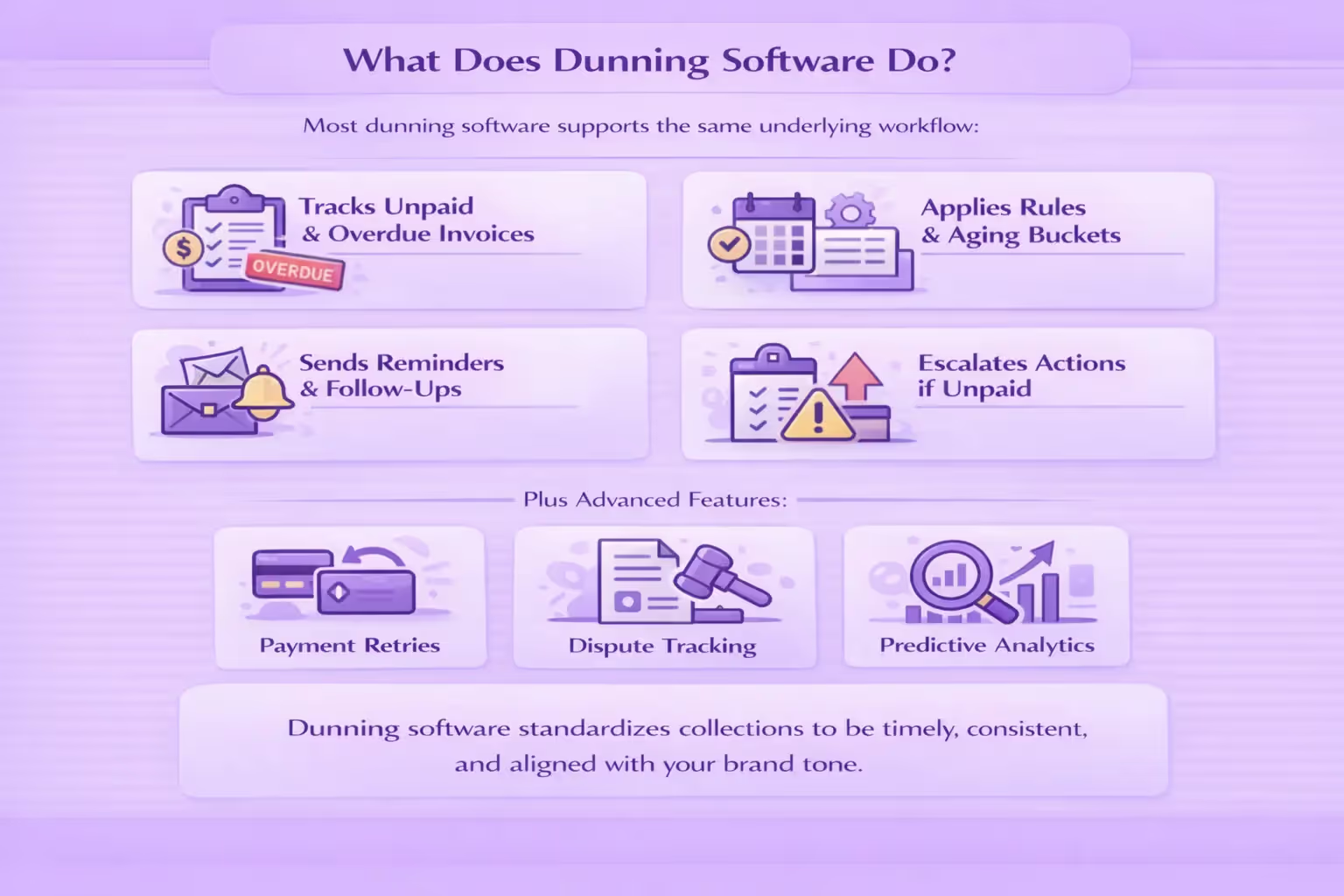
Most dunning software supports the same underlying workflow:
Tracks unpaid and overdue invoices
Applies rules based on due dates or aging buckets
Sends reminders or flags accounts for follow‑up
Escalates actions if invoices remain unpaid
More advanced tools may also include payment retries, dispute tracking, or predictive analytics.
Importantly, dunning software is not just about chasing payments, it’s about standardizing collections so they’re timely, consistent, and aligned with your brand tone.
Why Dunning Matters
Dunning matters because late payments are one of the most common causes of cash-flow problems. Even profitable businesses can feel financial pressure when invoices are paid late.
Without a clear dunning process, overdue invoices often slip through the cracks. Reminders are sent too late or not at all, messages vary from one person to another, and follow-ups depend on individual habits instead of a shared process.
Over time, this leads to higher days sales outstanding (DSO), more write-offs, and strained customer relationships.
Effective dunning brings structure to accounts receivable. It makes overdue invoices easy to spot, follow-ups more consistent, and communication more professional.
For accounting firms and family offices handling multiple entities, currencies, and stakeholders, this structure is key to maintaining clear and reliable financial oversight.
Before choosing a dunning approach, it helps to see how much cash is tied up in overdue invoices. This calculator provides an estimate based on your receivables (*not legal advice):
Overdue Cash Exposure Calculator
Estimate how much cash is currently tied up in overdue invoices.
Key Features of Dunning Software
While features vary by tool, most dunning software includes some combination of the following:
Invoice Aging & AR Visibility: A dunning system must clearly show which invoices are overdue, how long they've been unpaid, and how exposure is distributed across customers or entities. This is the foundation of any effective dunning process.
Automated or Semi‑Automated Reminders: Dedicated automated dunning software sends scheduled reminders based on predefined rules. Accounting platforms may instead support manual or semi‑automated follow‑ups using AR data.
Workflow Rules & Escalation Logic: Many dunning management tools support multi‑step processes including friendly reminders, firm notices, final notices, and escalation to collections or account review.
Customer Segmentation: Advanced tools allow different dunning strategies by customer type, invoice size, or risk profile.
Reporting & Analytics: Reporting helps teams track overdue balances, DSO, and collection effectiveness over time.
Accounting & ERP Integration: Dunning works best when tightly connected to accounting data. Integrations ensure invoices, payments, and credits stay in sync. This is where accounting‑first platforms like Eleven have a structural advantage.
Popular Dunning Software (and How They Compare)
Dunning software comes in several distinct categories.
Each category serves a different type of business and use case. Understanding these differences is more useful than comparing feature lists.
Below is an overview of widely used dunning and dunning‑adjacent tools, grouped by category.
SaaS‑Focused Dunning Platforms
Paddle Retain
Paddle Retain is a retention toolkit within Paddle Billing that includes dunning capabilities focused on recovering failed subscription payments. While primarily designed for churn prevention, its dunning features automate recovery of payments blocked by expired cards and payment failures, helping prevent involuntary churn through payment recovery workflows.
Core Features
Failed Payment Recovery & Dunning – Fully automated dunning system that detects failed payments due to expired or invalid cards and automatically sends recovery reminders. Adapts messaging based on failure reasons.
Automated Recovery Workflows – Multi-step dunning workflows that send personalized payment recovery messages and retry failed charges with optimized timing. Includes escalation logic for persistent payment failures.
Localized Payment Recovery Communication – Automatically translates dunning messages into customer-preferred languages, ensuring recovery communications are relevant and localized.
Works within billing stack – No need to change payment providers or integrate separate dunning system.
Support & Implementation
Pre-built recovery workflows – Comes configured out of the box with no additional setup required.
SOC2 certified and GDPR compliant – Security and compliance standards for payment recovery data.
Pricing
Included at no additional cost as part of Paddle Billing subscription service.
Best For: SaaS companies with recurring subscription models where involuntary churn from failed payments is a significant challenge. Designed for businesses already using Paddle Billing seeking dunning/payment recovery integrated within their billing platform. Not suitable for traditional invoice-based collections or B2B AR management.
ChurnBuster
ChurnBuster is a retention platform with specialized dunning capabilities focused on recovering failed subscription payments (passive churn). Its dunning module uses adaptive retry logic and sophisticated payment recovery workflows to recover revenue from declined payments, while its cancellation flows address voluntary churn prevention.
Core Features
Advanced Dunning & Failed Payment Recovery – Adaptive dunning system based on millions of recovery data points. Dunning logic adapts to specific decline codes, segments customer experiences, and optimizes retry timing to maximize payment recovery rates.
Intelligent Retry Logic – Smart payment retries that consider customer payment patterns, decline reasons, and account history. Moves beyond basic retries with strategic timing and personalized recovery messaging.
Recovery Campaign Management – Sophisticated dunning campaigns that combine automated reminders with customer segmentation and personalized messaging to recover failed payments.
Transparent Recovery Attribution – Distinguishes actual recovered revenue from natural recoveries, ensuring clarity on dunning effectiveness without inflated metrics.
Integration & Platform Support
Multiple platform support – Integrates with Stripe, Shopify, Recharge, Loop, Skio, Smartrr, and more.
API integration available – Flexible integration options for custom implementations.
Support & Implementation
Expert-guided setup – Concierge onboarding with retention specialists providing account reviews and optimization.
Strategic partnership approach – Ongoing advisory services and optimization, not just software.
10+ years of retention expertise – Team has deep eCommerce and B2B/SaaS recovery experience.
Pricing
Starts at $249/month. No contracts; can cancel anytime. ROI-focused pricing with performance guarantees.
Best For: SaaS and subscription businesses with significant failed payment recovery needs where involuntary churn is a revenue challenge. Particularly suited for companies seeking expert guidance on dunning strategy alongside automation. Not designed for traditional invoice-based AR or B2B collections.
Chargebee Retention
Chargebee Retention is a retention platform focused on preventing voluntary churn through intelligent dunning at the point of cancellation. Built on Chargebee Billing, it addresses churn through personalized retention offers and cancellation deflection workflows rather than failed payment recovery, but represents a dunning approach focused on retaining subscribers before they cancel.
Core Features
Cancel Page Dunning & Deflection – Instead of traditional dunning reminders, Chargebee uses cancel pages as dunning touchpoints, presenting personalized offers and retention messaging to customers attempting to cancel.
Intelligent Offer Dunning – AI-powered offers determined by customer attributes (LTV, usage, tenure, plan value). Different dunning strategies are presented to different customer segments at the cancellation moment.
Multivariate Testing for Dunning – A/B test different dunning messages, offers, and retention strategies to optimize which approaches prevent cancellations most effectively.
Cancellation Reason Capture – Gathers why customers are attempting to cancel, providing insights to improve future dunning strategies and address root causes.
Dunning Analytics & Deflection Tracking – Real-time dashboards showing dunning effectiveness, deflection rates, and revenue impact of retention offers.
Integration & Platform Support
Integrated with Chargebee Billing – Two-way integration with Chargebee customer portal for seamless dunning at cancellation moment.
Multiple platform support – Works with Chargebee, Stripe, Recurly, with API options for custom integration.
Structured onboarding – Typically deployed within a few weeks with guided implementation process.
Tiered support – Email support on Essentials; dedicated account manager on Performance plan.
Customizable branding – White-label dunning experiences that match company brand.
Pricing
Performance plan starts at $3,750/month for 50-149 sessions per month. Usage-based pricing scales with dunning volume. Enterprise plans available with custom pricing.
Best For: Subscription businesses using or considering Chargebee Billing that want to prevent voluntary churn through dunning at the cancellation moment. Particularly valuable for companies wanting to test different dunning/retention offers at scale. Not designed for involuntary churn (failed payments) or traditional invoice-based B2B collections.
AR & Collections‑Focused Dunning Tools
Gaviti
Gaviti is an AI-powered accounts receivable platform with comprehensive dunning and collections automation capabilities. Designed for finance teams managing large invoice volumes, Gaviti provides sophisticated collection workflows, intelligent prioritization, and centralized visibility across single or multiple ERPs.
Core Features
Automated Collections Workflows & Dunning – Define and automate dunning actions based on invoice aging, due dates, payment history, and credit terms. Automatable reminders, escalations, and follow-ups based on predefined criteria.
Intelligent Collections Prioritization – Algorithms prioritize dunning efforts based on payment history, customer creditworthiness, and invoice amount. Focuses collection actions on high-value and high-risk accounts.
Centralized Collections Visibility – Unified view of A/R across single or multiple ERP systems. Real-time visibility into outstanding balances, customer payment history, and collections status in one platform.
Task Management & Workflow Automation – Assign collections tasks, set due dates, and track progress. Automate repetitive dunning tasks and streamline workflows to improve team productivity.
Customizable Collections Strategies – Configure escalation rules, define dunning communication templates, and tailor collections strategies to match business requirements and customer segments.
Multi-ERP support – Works seamlessly with ERP systems to consolidate A/R data into single view without requiring system changes.
Award-winning ease of use – Recognized by G2 as easiest to do business with and easiest to administer.
Support & Implementation
Flexible configuration – Users customize collections workflows and dunning strategies to match existing processes rather than changing processes to fit software.
Customer interaction tracking – Centralized system to capture and record customer interactions (calls, emails, notes) for meaningful collections conversations.
Pricing
Custom pricing based on invoice volume and company requirements. Usage-based model with no per-user fees. Contact Gaviti for quote.
Best For: Mid-to-large enterprises with significant invoice volumes requiring sophisticated, customizable dunning automation integrated with broader AR operations. Particularly valuable for organizations using on-premise ERP systems, managing multiple entities, or handling complex collections workflows. Not designed for SaaS subscription businesses, failed payment recovery, or standalone dunning systems.
HighRadius
HighRadius is an enterprise-grade autonomous finance platform with comprehensive collections management and dunning capabilities. Designed for large organizations, it uses AI-driven prioritization and orchestrated agents to automate dunning workflows, accounts receivable management, and collections optimization across complex environments.
Core Features
AI-Driven Collections & Dunning Automation – Automated dunning workflows with AI-powered prioritization of collections activities. Intelligent algorithms prioritize dunning efforts across thousands of invoices based on payment likelihood and customer value.
Customer Segmentation & Predictive Collections – AI agents for customer segmentation using K-Means ML and payment date prediction using Random Forest & Gradient Tree models. Enables targeted dunning strategies by customer risk and behavior.
Intelligent AR Inbox & Copilot – AI-powered AR Inbox using RAG and GenAI LLMs, with AR Co-Pilot assistant that optimizes dunning communications and provides actionable insights for collections teams.
Multi-Step Collections Workflows – Supports complex, customizable dunning workflows with escalation rules, task management, and intelligent worklist prioritization. Handles high-volume collections automation at enterprise scale.
Collections Analytics & Forecasting – Real-time dashboards and analytics tracking DSO, collections performance, customer payment patterns, and collection effectiveness. Identifies trends and optimization opportunities.
In-App Dialer & Payment Capture – Built-in collections communication tools including in-app dialer for customer outreach and in-app payment capture to reduce friction in payment collection process.
Integration & Platform Support
Multi-ERP support – Pre-built integrations with 50+ ERP systems and accounting platforms. Works across complex enterprise environments without requiring system changes.
Enterprise-scale architecture – Designed for large organizations managing high invoice volumes across multiple entities and business units.
Support & Implementation
AI agents for orchestration – 180+ AI agents orchestrated on single platform for end-to-end collections process automation, not siloed individual solutions.
Speed-to-Value implementation – Structured implementation methodology designed for rapid value realization in enterprise environments.
Industry-recognized leader – Gartner Magic Quadrant 3X Leader for Invoice-to-Cash Applications and IDC Market Scape Leader for embedded payments.
Pricing
Custom enterprise pricing. Contact HighRadius for quote based on organization size and requirements.
Best For: Large enterprises with significant A/R volumes, complex collections environments, and multiple entities requiring AI-powered dunning automation integrated within broader finance operations. Particularly valuable for Fortune 500 companies and mid-market organizations managing high-volume, complex collections across multiple business units and geographies. Not designed for small businesses, SaaS subscription models, or standalone dunning systems.
Accounting Platform With Dunning Support
Eleven
Eleven is an accounting platform built for accounting firms and family offices managing multiple client entities. While not a dedicated dunning system, it provides accounts receivable (AR) functionality that supports dunning processes. Eleven treats dunning as part of the accounting workflow rather than as a separate system.
Core Features Supporting Dunning
Accounts Receivable Visibility – Centralized AR dashboard providing visibility into outstanding invoices across multiple client entities.
Invoice Tracking & Aging – Automated invoice aging and tracking of overdue invoices, enabling identification of past-due amounts by customer and aging category.
Multi-Entity Accounting Support – Consolidated AR management across unlimited client entities. Allows consistent AR management across entire client portfolios.
Multi-Currency Handling – Support for 170+ currencies with automatic FX calculations and IAS 21 compliance. Relevant for firms managing international AR.
Bank Reconciliation – Automated bank feeds and reconciliation to match received payments to invoices, providing visibility into which invoices have been paid.
Integrated Document Management – Centralized storage and retrieval of invoices and supporting documents, accessible within the accounting platform.
Integration & Platform Approach
Dunning within accounting workflow – AR and dunning operate within the native accounting system rather than requiring a separate specialized platform.
Unified AR and accounting data – All AR information (invoices, payments, aging, notes) resides in the same system as the general ledger.
Role-based access controls & audit trails – Permission controls and audit logs on transactions.
Support & Implementation
Purpose-built for accounting firms – Designed for firms managing multi-entity portfolios.
Approval workflows – Supports approval workflows and compliance requirements.
Scalable architecture – Supports unlimited transactions and entities.
Pricing: Three-tier pricing (Standard, Professional, Enterprise) based on number of client entities. Standard starts at $126/month when billed annually (5 entities included); Professional at $381/month when billed annually (20 entities included); Enterprise custom pricing for 50+ entities.
Best For: Accounting firms and family offices that prefer to manage dunning within their core accounting platform rather than through specialized external dunning tools. Particularly relevant for firms managing multiple client entities that want centralized AR management. Not designed to replace specialized dunning platforms like Gaviti or HighRadius, but offers an alternative approach to AR management for accounting-focused organizations.
Choosing the Right Dunning Software
You probably already know you need dunning software. The real question is which one, because the wrong choice wastes money and creates more work, not less.
The temptation is to compare features. Don't. Most dunning tools have similar features. What matters is whether the tool fits how your business actually operates.
Here's what actually matters when you're evaluating:
Business Model Fit
The first consideration is your business model.
Subscription-based companies typically benefit from automated dunning software designed around failed payments, card retries, and churn reduction. These tools are optimized for recurring billing rather than traditional invoicing.
Invoice-based organizations, such as professional services firms, family offices, and operating companies, often require dunning that is tightly connected to accounts receivable rather than standalone payment recovery. In these cases, visibility into invoice status and aging is often more valuable than aggressive automation.
Level of Automation vs. Control
The second consideration is how much automation you actually need.
High-volume finance teams may benefit from fully automated, multi-stage dunning workflows with escalation logic and prioritization rules.
Other organizations prefer greater control. They may rely on accounting data to identify overdue balances and then handle outreach manually or semi-automatically. For these teams, accuracy, consistency, and auditability matter more than hands-off automation.
Accounting Complexity
Entity and currency complexity plays a major role in dunning effectiveness.
Managing overdue invoices across multiple legal entities, jurisdictions, or currencies significantly increases the importance of centralized and reconciled accounting data.
In complex environments, dunning is only as effective as the ledger behind it. Inaccurate balances or unreconciled transactions undermine even the most advanced dunning automation.
Where Eleven Fits
This is where accounting-first platforms like Eleven play a distinct role.
Eleven does not attempt to replace specialized automated dunning software. Instead, it ensures that any dunning process, manual, semi-automated, or automated, is built on reliable, multi-entity accounting data.
For accounting firms and family offices, this approach aligns dunning with core accounting workflows rather than treating collections as a separate operational layer.
Final Thoughts
Dunning software is about staying in control of late payments. It helps teams protect cash flow, communicate clearly, and reduce the risk that unpaid invoices create.
Some organizations need dedicated dunning management software to automate reminders and scale collections. Others benefit more from strong accounting foundations.
Platforms like Eleven support dunning by keeping accounts receivable data accurate, visible, and easy to manage. When dunning is handled within the accounting process, it is more consistent and far less disruptive.
If you want to see how this approach works in practice, book an Eleven demo to see how clear AR visibility, multi-entity accounting, and reconciled data help teams manage late payments with more confidence.
Noel Bouwmeester is an SEO content strategist and B2B SaaS writer focused on organic growth, search visibility, and AI-era content discovery. He has contributed to SEO and content marketing initiatives for companies including lempire and lemlist, helping support large-scale organic traffic growth through search-focused content strategies. At Eleven, he contributes educational SEO content focused on accounting technology, automation, and AI-driven business workflows.




.avif)