Intercompany Accounting Best Practices: How to Reduce Errors and Close Faster
Learn the most effective intercompany accounting best practices to reduce errors, simplify reconciliation, and improve consolidation across entities.
Intercompany accounting often breaks down due to mismatches, timing issues, and manual processes. This guide outlines practical best practices to prevent errors, improve consistency, and give finance teams better control over multi-entity operations.
In this article
Intercompany accounting breaks down in predictable ways.
And they usually show up at the worst possible moment: During close.
If your team is chasing intercompany differences late in the process, you are not alone.
Intercompany accounting is not just a technical requirement. It is a coordination problem across entities, systems, and teams. And without the right structure, small inconsistencies quickly turn into major reporting issues.
This guide focuses on intercompany accounting best practices. The ones that actually reduce errors, speed up reconciliation, and make consolidation far less painful.
What Is Intercompany Accounting?
Intercompany accounting is the process of recording, reconciling, and reporting financial transactions between entities within the same corporate group.
When two entities within the same group transact, those activities must be treated with the same rigor as external transactions. They must then be eliminated during consolidation to avoid double-counting revenues, expenses, assets, and liabilities.
That sounds simple. It rarely is.
The process spans the full transaction lifecycle. From initiation to final reporting.
And it requires coordination across finance, accounting, tax, and legal teams.
You do not need to be a multinational to feel the impact.
Any organization with more than one legal entity is dealing with intercompany accounting.
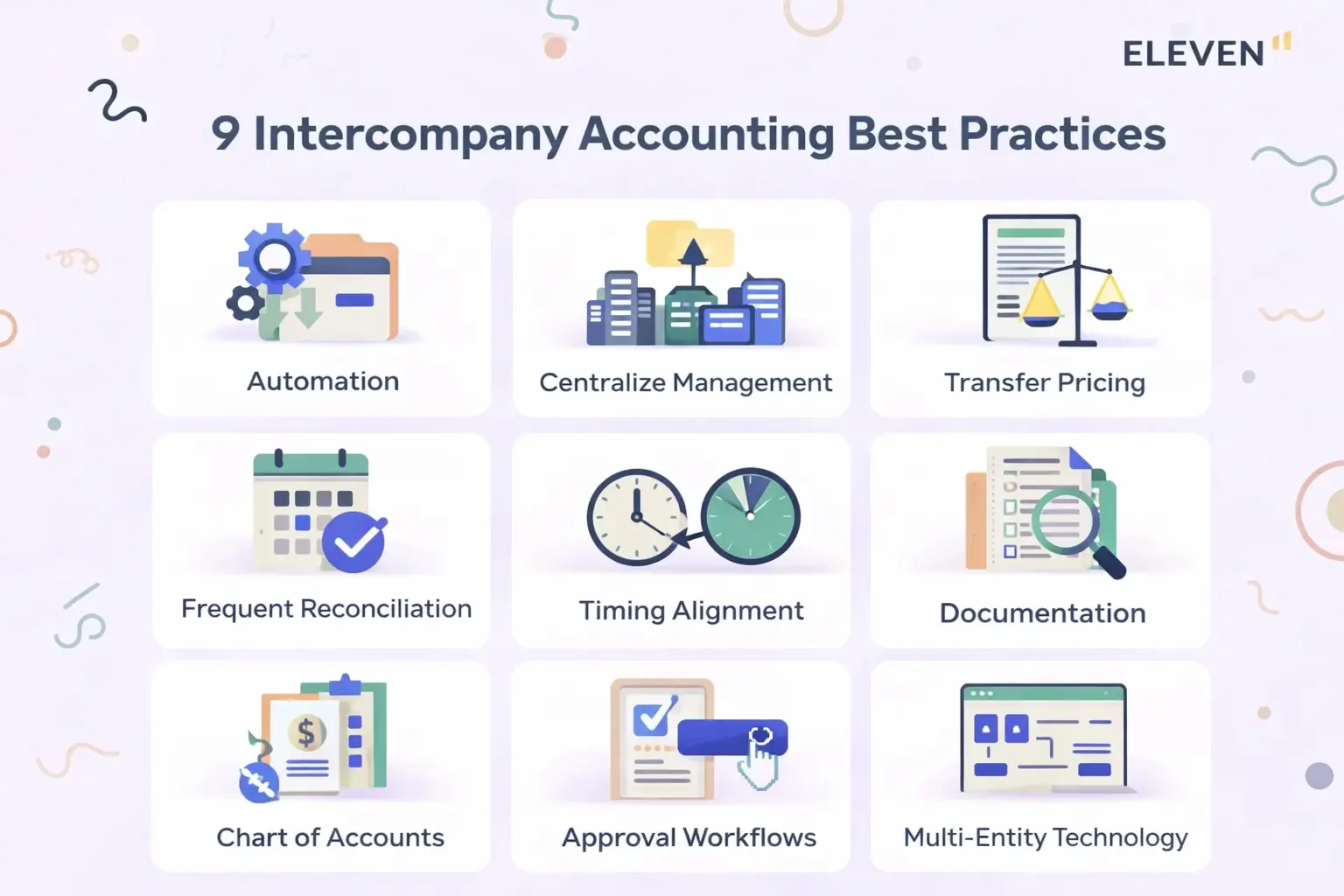
Intercompany Accounting Best Practices
Most intercompany problems show up during close.
But they usually start much earlier.
The practices below focus on preventing issues before they happen, not just fixing them at the end.
1. Automate Intercompany Transactions
Manual processes create inconsistencies.
Different formats. Missing entries. Delays in recognition.
Automation standardizes how transactions are recorded and matched across entities. It ensures both sides of a transaction follow the same logic, which significantly reduces reconciliation effort later.
It also frees up finance teams to focus on analysis instead of chasing mismatches.
2. Centralize Intercompany Management
Decentralized handling leads to fragmentation.
Each entity develops its own way of recording transactions. Over time, those differences compound and create friction during consolidation.
A centralized approach ensures consistency.
Same rules. Same structure. Same expectations.
This does not mean removing local flexibility entirely. It means defining a shared framework that all entities follow.
3. Standardize Transfer Pricing Policies
Transfer pricing is one of the most sensitive areas in intercompany accounting.
Without clear policies, entities may apply inconsistent pricing methods. That creates both compliance risks and reconciliation issues.
Define pricing methodologies clearly. Document them. Apply them consistently across all entities.
And review them regularly. Tax regulations evolve, and your policies need to keep up.
4. Reconcile Frequently (Not Just at Close)
Waiting until period-end to reconcile is one of the most common mistakes.
By then, discrepancies are harder to trace. People forget details. Supporting documentation gets buried.
Regular reconciliation, ideally monthly or even continuous, keeps issues small and manageable.
It also makes the close process faster and far less stressful.
5. Align Timing Across Entities
Timing differences are subtle but damaging.
One entity records a transaction in December. The other records it in January. Now your numbers do not align.
Define clear cut-off rules and enforce them across all entities.
Make sure everyone is working on the same timeline.
This alone eliminates a large percentage of reconciliation issues.
6. Maintain Strong Documentation
Every intercompany transaction should have a clear audit trail.
This includes:
Pricing rationale
Agreements between entities
Approval records
Good documentation is not just for auditors. It helps internal teams understand transactions and resolve discrepancies faster.
If you cannot explain a transaction quickly, it becomes a problem later.
7. Use a Standard Chart of Accounts
Different account structures across entities create confusion.
Matching transactions becomes harder. Eliminations become more error-prone.
A standardized chart of accounts simplifies everything.
It ensures transactions are recorded consistently and can be matched easily during consolidation.
8. Implement Clear Approval Workflows
Uncontrolled entries introduce risk.
Approval workflows ensure that intercompany transactions are reviewed before they impact financial reporting.
This adds a layer of control without slowing things down too much. Especially when combined with automation.
9. Use Technology Built for Multi-Entity Accounting
As transaction volume grows, so does the risk of errors, inconsistencies, and delays.
Modern accounting platforms centralize intercompany workflows, automate reconciliation, and provide real-time visibility across entities.
Platforms like Eleven are designed to handle these complexities. They reduce manual work, enforce consistency, and make it easier to manage intercompany relationships at scale.
Types of Intercompany Transactions
Intercompany transactions generally fall into four categories:
Sales and purchases: One entity sells goods or services to another within the group. These transactions must be priced correctly and documented properly, especially for tax purposes.
Loans and financing: When one entity lends money to another, the arrangement must include clear terms. Interest rates, repayment schedules, and legal compliance all matter.
Transfer pricing: This determines how goods, services, or intellectual property are priced between entities. It directly affects tax liabilities and is heavily scrutinized by tax authorities.
Expense allocations: Shared costs such as IT, HR, or management services must be distributed across entities. The allocation method should be consistent and defensible.
Transaction Type
Description
Key Risk
Sales & Purchases
Goods or services exchanged between entities within the same group.
Incorrect or inconsistent pricing
Loans & Financing
Intercompany lending arrangements with defined terms and interest rates.
Regulatory and compliance issues
Transfer Pricing
Pricing of goods, services, or IP transferred between related entities.
Tax authority scrutiny
Expense Allocations
Distribution of shared costs like IT, HR, or management services.
Unfair or inconsistent allocation methods
Why Intercompany Accounting Matters
At its core, intercompany accounting prevents double-counting.
Without proper elimination of intercompany transactions, consolidated financial statements become distorted. Revenues and expenses are overstated. The group’s performance becomes unclear.
But accuracy is only part of the story.
It is also a compliance issue. Tax authorities expect intercompany transactions to follow strict rules, particularly around transfer pricing.
Mistakes can lead to audits, penalties, and back taxes.
There is also a strategic benefit.
Clean intercompany data gives visibility into how the group actually operates.
Where costs sit. Which entities are profitable. Where inefficiencies exist.
Without that clarity, decisions rely on incomplete information.
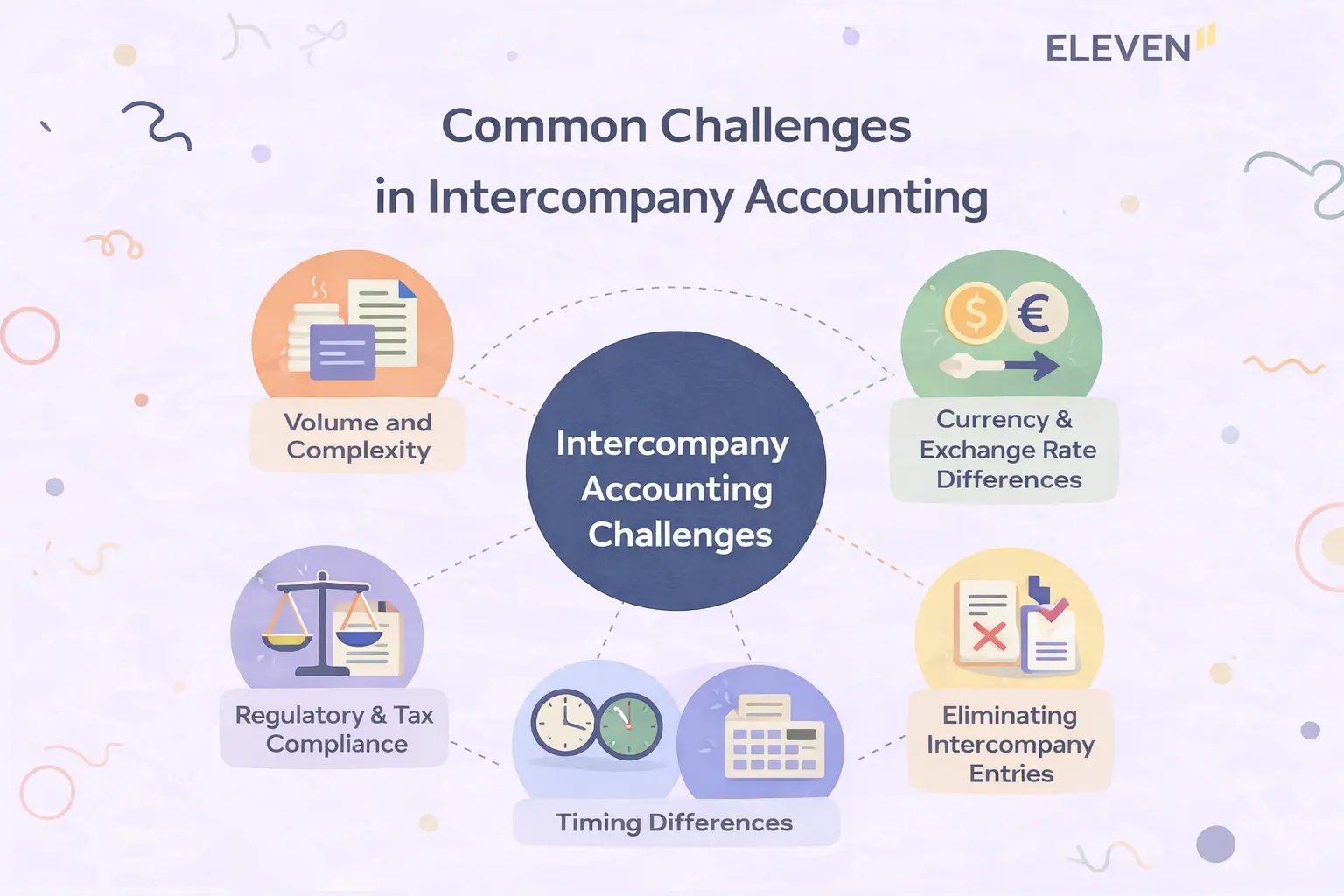
Common Challenges in Intercompany Accounting
Even with structure in place, certain problems tend to surface again and again.
These are the areas where intercompany accounting becomes difficult to manage:
Volume and Complexity
As organizations grow, intercompany transactions increase rapidly.
What starts as a few entries becomes hundreds or thousands. Across multiple entities, currencies, and jurisdictions.
Transactions must be recorded using the correct exchange rates.
Any fluctuations between transaction and settlement must be accounted for.
Inconsistent handling leads to discrepancies that are difficult to trace.
Regulatory and Tax Compliance
Each jurisdiction has its own rules.
Companies must comply with multiple tax systems simultaneously.
Transfer pricing requirements add another layer of complexity.
Tax authorities are increasingly strict in this area.
Timing Differences
Entities often record transactions at different times.
These mismatches create reconciliation issues and distort consolidated reporting until resolved.
This is one of the most common and preventable challenges.
Eliminating Intercompany Entries
Eliminations are essential for accurate consolidation.
But they are also one of the most error-prone steps.
Especially when handled manually.
A single missed elimination can impact the entire financial statement.
And the issue is often discovered late, when there is little time to fix it.
The Role of Technology in Intercompany Accounting
Technology is no longer optional.
At scale, spreadsheets cannot handle the complexity of intercompany accounting.
Most organizations rely on three types of tools:
ERP systems: They centralize financial data and support transaction recording across entities.
Specialized intercompany solutions: These tools handle reconciliation, matching, and multi-entity workflows more effectively than general systems.
Analytics and reporting tools: They provide visibility into intercompany activity and help identify anomalies.
The real value of technology is not just speed.
It is consistency.
Visibility.
And confidence in your numbers at close.
Conclusion
Intercompany accounting is complex by nature. That does not change.
But most of the problems organizations face are avoidable.
The right practices reduce errors before they happen. Not just fix them during close.
Automation, standardization, and clear processes make a measurable difference.
They reduce reconciliation time, improve accuracy, and lower compliance risk.
Teams that get this right do more than close faster. They actually trust their numbers.
And that changes how decisions get made.
If you want to see what that looks like in practice, you can try Eleven yourself. Start a free test drive here: https://www.runeleven.com/test-drive
Frequently Asked Questions
What are intercompany transactions?
Intercompany transactions are financial activities between entities within the same corporate group. These include sales, loans, asset transfers, and shared expense allocations.
How does accounting software improve intercompany accounting?
It automates transaction recording, matching, and reconciliation. This reduces manual errors, speeds up close, and ensures consistency across entities.
Why is transfer pricing important?
Transfer pricing determines how profits are distributed across jurisdictions. It directly impacts tax liabilities and must comply with strict regulatory requirements.
What is the typical accounting entry for an intercompany payable?
When one entity buys goods or services from another, the buying entity records a debit to an expense or asset and a credit to intercompany payable, while the selling entity records a debit to intercompany receivable and a credit to revenue. Both sides must match and are eliminated during consolidation to avoid double-counting.
Noel Bouwmeester is an SEO content strategist and B2B SaaS writer focused on organic growth, search visibility, and AI-era content discovery. He has contributed to SEO and content marketing initiatives for companies including lempire and lemlist, helping support large-scale organic traffic growth through search-focused content strategies. At Eleven, he contributes educational SEO content focused on accounting technology, automation, and AI-driven business workflows.




.avif)