What Is Multi-Entity Accounting? Definition, Challenges, and Software
If you're managing more than one legal entity, your accounting setup is either built for it, or quietly creating risk. Here's what multi-entity accounting actually requires.
Multi-entity accounting isn't just more of the same work. It's a different problem entirely. This guide covers the structure, software, and practices finance teams need to stay in control across multiple legal entities.
In this article
We don’t have to tell you that managing the finances of one company is hard.
But managing the finances of multiple legally separate companies is a different problem entirely. It becomes a coordination challenge involving data, access, eliminations, and compliance, not just bookkeeping.
Multi-entity accounting exists to address this problem. It enables organizations to maintain accurate ledgers for each legal entity while producing consolidated financial reports at the group level.
Understanding how multi-entity accounting works, and what it requires in practice, is the first step to managing this complexity without relying on spreadsheets.
What Multi-Entity Accounting Actually Means
At its core, multi-entity accounting means recording, reconciling, and reporting financial results for more than one legal entity within the same organization.
These entities can include subsidiaries, branches, divisions, or other legally separate companies operating under a shared corporate structure.
Each entity usually keeps its own general ledger, chart of accounts, bank accounts, and statutory reports. Finance teams must keep these records separate while also producing consolidated financial staements that show the organization’s overall performance.
Consolidation brings entity-level data together into group reports by eliminating internal transactions, aligning accounting policies, and handling currency differences when entities operate across countries.
Common Business Structures That Require Multi-Entity Accounting
Business Structure
Typical Entity Types
Primary Reason for Multi-Entity Accounting
Holding companies and subsidiaries
Parent company and operating subsidiaries
Each subsidiary must maintain separate books, tax filings, and regulatory reports while enabling consolidated oversight
Family offices and investment portfolios
Special-purpose vehicles (SPVs) and investment holding companies
Legal separation of assets and liabilities combined with consolidated portfolio-level reporting
International operations
Local legal entities across multiple jurisdictions
Compliance with differing currencies, tax regimes, and accounting standards in each country
Accounting and professional services firms
Client entities, funds, and separate business lines
Clear legal, compliance, and reporting boundaries across multiple managed entities
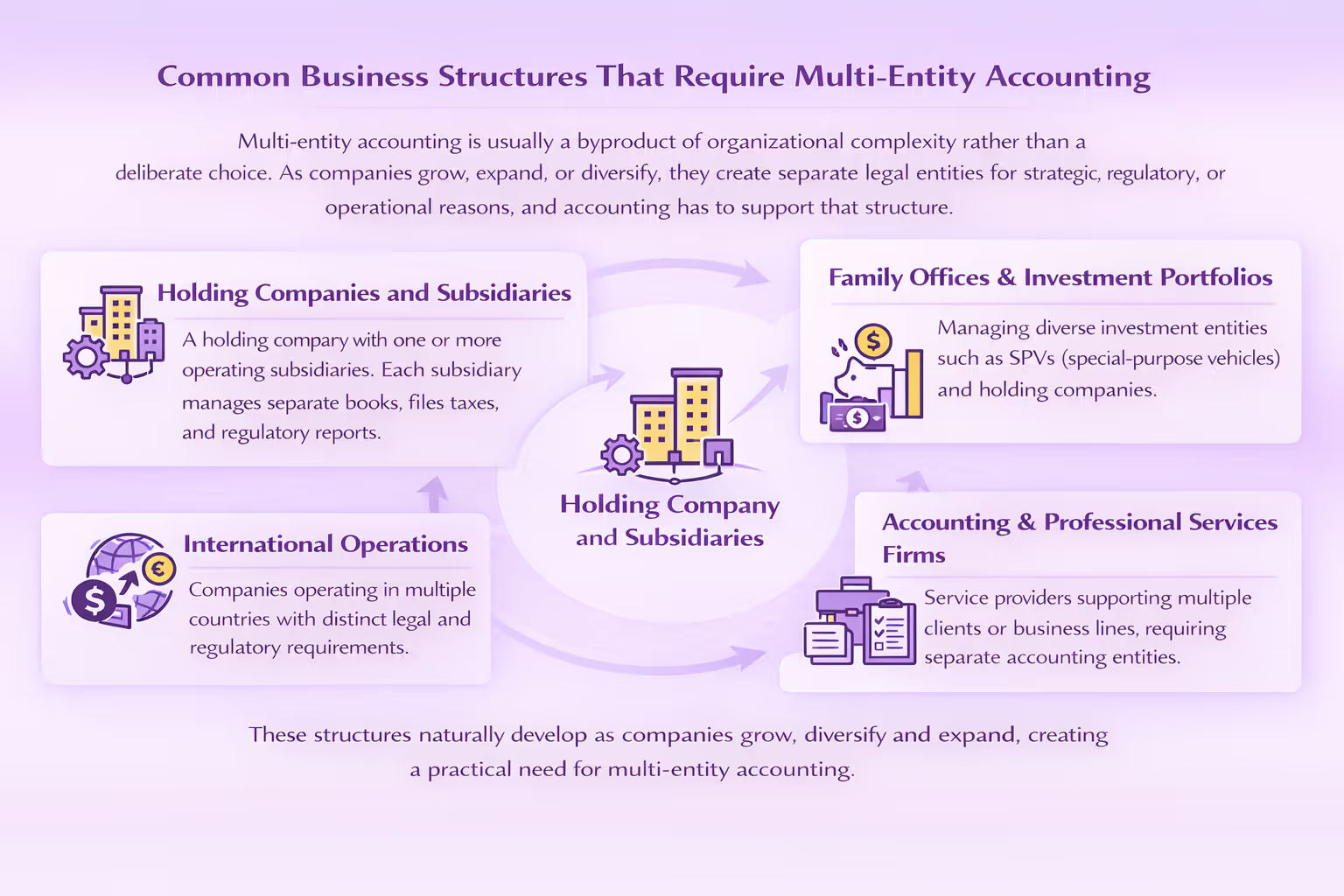
Multi-entity accounting is usually a byproduct of organizational complexity rather than a deliberate choice. As companies grow, expand, or diversify, they create separate legal entities for strategic, regulatory, or operational reasons, and accounting has to support that structure.
The following examples illustrate the types of business structures where multi-entity accounting becomes a practical requirement:
Holding companies and subsidiaries
A common example is a holding company with one or more operating subsidiaries.
Even when fully owned, each subsidiary is a separate legal entity and must maintain its own books, tax filings, and regulatory reports, while results are ultimately consolidated at the group level.
Family offices and investment portfolios
Family offices and investment groups often manage portfolios made up of many legal entities, such as special-purpose vehicles and investment holding companies.
Each entity must remain legally distinct, while the organization still needs clear, consolidated visibility across the entire portfolio.
International operations
Companies operating across borders typically establish local legal entities to comply with local tax, payroll, and regulatory requirements.
These entities may use different currencies or accounting standards, which adds complexity when financial results are consolidated at the group level.
Accounting and professional services firms
Accounting firms, family-office service providers, and other professional services organizations can also face multi-entity requirements.
Supporting multiple clients, funds, or business lines often means managing separate accounting entities with clear legal and operational boundaries.
Multi-entity accounting is more complex than single-entity work because it involves coordinating across boundaries that accounting systems were not originally designed to handle. Here are the key reasons complexity arises:
1. Fragmented Systems Amplify Work
Many accounting tools treat each entity as a separate file or database. This forces finance teams to export data entity by entity to consolidate reports, which is time-consuming and error-prone.
2. Manual Consolidation Holds Back Finance Teams
Without automated consolidation, finance teams rely on spreadsheets to combine entity data, adjust for intercompany transactions, and align accounting policies. Manual work increases the risk of errors and slows closing cycles.
3. Intercompany Transactions Create Extra Work
Entities within the same group frequently transact with each other. These internal transactions must be identified and eliminated during consolidation to prevent double-counting and ensure accurate reporting.
4. Multi-Currency Translation Adds Complexity
When entities operate in different currencies, finance teams must translate local financials into a single reporting currency. This often involves complex currency adjustments and can significantly slow reporting processes.
5. Governance and Permissions Grow Harder
As the number of entities increases, so does the complexity of managing who can view and edit what data. Keeping audit trails and secure access consistent across entities becomes a governance challenge.
What a Reliable Multi-Entity Accounting Setup Requires
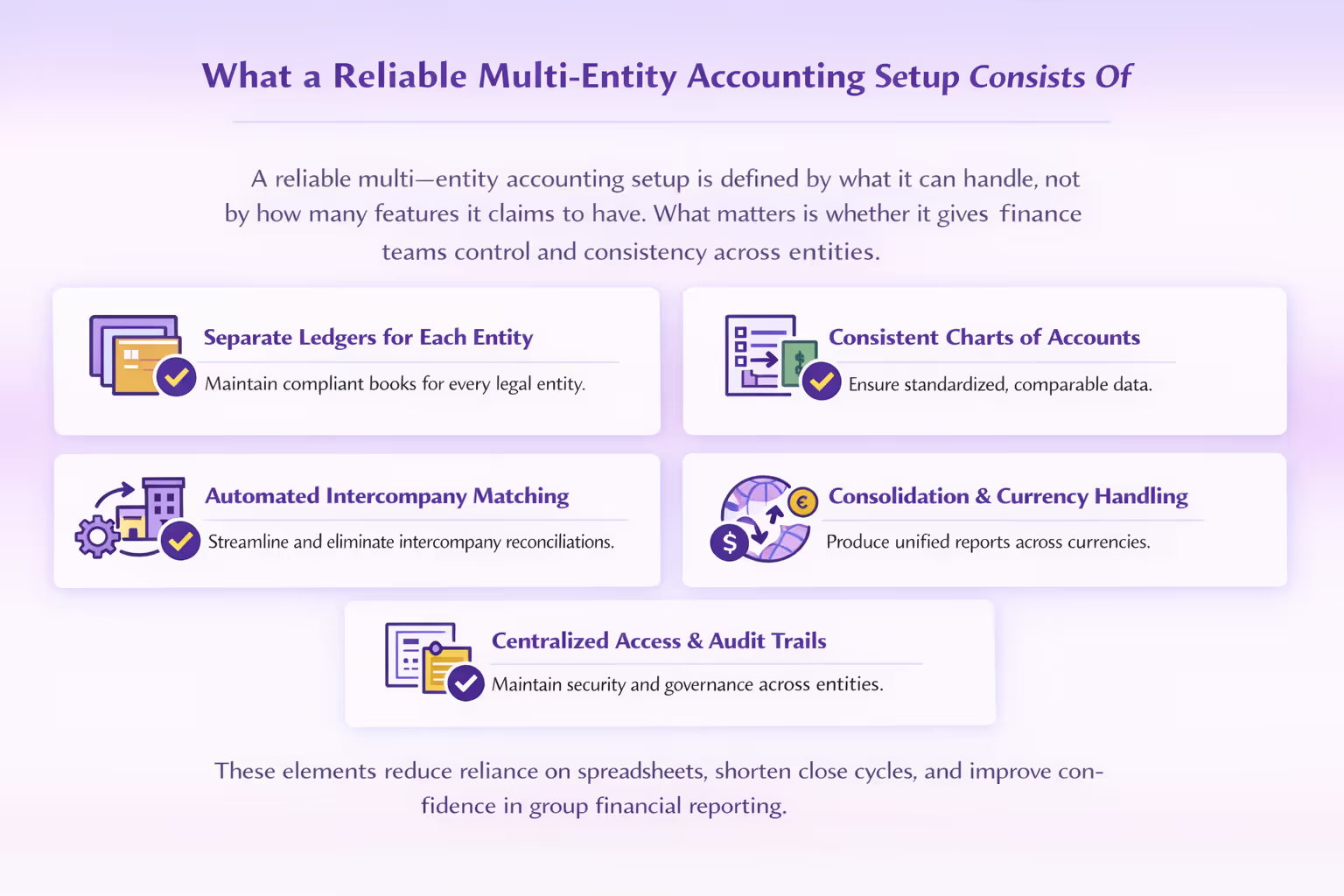
A reliable multi-entity accounting setup is defined by what it can handle, not by how many features it claims to have. What matters is whether it gives finance teams control and consistency across entities.
Here’s what a reliable multi-entity accounting setup needs:
Separate, compliant ledgers for each entity that allow every legal entity to maintain its own books in line with tax and regulatory requirements.
Consistent charts of accounts or reliable mappings across entities so financial data can be compared and consolidated accurately at the group level.
Automated intercompany matching and elimination to reduce manual reconciliation work during consolidation.
Built-in consolidation logic with currency handling to produce unified financial statements that account for exchange rates and translation adjustments.
Centralized access controls and audit trails to manage permissions, support governance, and protect data integrity across entities and teams.
Together, these elements reduce reliance on spreadsheets, shorten close cycles, and improve confidence in group financial reporting.
Best Practices for Multi-Entity Accounting
Getting the structure right is only part of the work. How finance teams operate within that structure day-to-day determines whether multi-entity accounting stays manageable as complexity grows.
Practice
Why It Matters in a Multi-Entity Context
Align close schedules across entities
Staggered or ad-hoc close timelines create bottlenecks at consolidation. Sequencing entity closes deliberately makes group reporting more predictable and reduces last-minute reconciliation pressure.
Review intercompany balances regularly, not just at period end
Mismatches are easier to resolve when caught early. A monthly or weekly intercompany review prevents small discrepancies from compounding into significant reconciliation work at close.
Assign data quality ownership at the entity level
Consolidated reporting is only as accurate as the entity-level data feeding into it. Distributing accountability to a responsible person per entity catches errors closer to their source.
Document currency and accounting policy decisions centrally
When entities apply judgment in areas like revenue recognition or asset valuation, those decisions need to be recorded consistently. This keeps consolidation adjustments reliable and supports audit readiness across the group.
Treat access controls as a living configuration
Permissions that made sense at setup can quickly become outdated as teams change and entities are added. Regular access reviews keep governance tight without creating bottlenecks.
Multi-Entity Accounting Software
Here's something important you need to know:
Not all accounting systems are built to handle the legal, operational, and reporting needs that come with managing multiple entities.
Multi-entity accounting software should give finance teams real-time visibility across several companies in a single environment, instead of forcing them to switch between entities or export data one by one. Here's what to look for in a solution that does:
Real-time multi-entity visibility: Multi-entity accounting software should give finance teams real-time visibility across several companies in a single environment, instead of forcing them to switch between entities or export data one by one.
Built-in consolidation: A reliable system also needs built-in consolidation so group reports can be created without relying on spreadsheets or manual exports. This includes clear handling of intercompany transactions, which helps teams manage eliminations and internal reconciliations as part of the normal consolidation process.
Currency translation: When entities operate in different currencies, the software must apply consistent currency translation and adjustment rules to keep group-level reports accurate.
Access controls and audit trails: Centralized, role-based access controls and clear audit trails are needed to maintain governance as more users and entities are added.
Together, these capabilities reduce manual work, lower control risk, and help finance teams report faster and more consistently across the organization.
Best Multi-Entity Accounting Software for CPA Firms and Family Offices
Eleven is an accounting platform designed for organizations that manage multiple legal entities, including family offices, CPA practices, and groups with complex portfolios. It gives finance teams direct visibility and centralized control across multiple companies within a single environment.
From a central multi-company admin panel, users can see all entities at a glance and manage access for collaborators from one place.
Within the bookkeeping module, authorized users can work with multiple companies and different fiscal years at the same time, which makes it easier to compare ledgers side by side without repeatedly logging in and out.
Eleven does not impose limits on the number of companies or fiscal periods a user can manage. This supports firms that oversee many client books or large portfolios of subsidiaries.
The platform also supports more than 170 currencies, allowing currency selection at the journal-line level and automatically calculating realized and unrealized foreign exchange gains and losses.
Source documents are stored directly alongside transactions, and built-in reporting tools reduce the need for external systems during audits or consolidated reporting.
Permissions and audit trails are managed centrally, which helps organizations maintain governance and reduce security risk as their multi-entity setup grows.
Practical Evaluation Checklist
Use this checklist to assess whether a multi-entity accounting solution meets your needs:
☐ Can it produce consolidated reports natively? If consolidation requires spreadsheets or external tools, close cycles will stay long.
☐ Does it support streamlined intercompany transaction management? Manual eliminations increase error risk; solutions that simplify intercompany workflows reduce complexity.
☐ Does it handle multi-currency translation? This is essential for international groups.
☐ Are permissions granular and centralized? Governance depends on proper access controls.
☐ Does it integrate with a document management system? Integrations with tools like Dokmee can significantly speed up audits and reconciliation.
☐ Does pricing scale at the organization level? Per-accountant or per-firm pricing often scales better than per-entity licensing.
This checklist helps teams distinguish between tools that claim multi-entity capability and tools that deliver operational efficiency.
4 Steps to Move to Multi-Entity Accounting Safely
To ensure a smooth transition to multi-entity accounting, organizations should focus on reducing risk at every stage of the process. Here are the key steps to follow:
Standardize or formally map your chart of accounts before migrating: Consistent account structures across entities make consolidation faster and reduce the need for manual reclassification entries. Where full standardization is not possible, a documented mapping layer is essential.
Start with a representative subset of entities: Piloting the setup with a mix of entities (for example, one operating company, one holding entity, and one foreign subsidiary) helps validate consolidation logic, intercompany rules, and access permissions before scaling.
Define and automate intercompany transaction rules early: Intercompany activity is a primary source of reconciliation work. Automating recurring transactions such as management fees, cost recharges, or intercompany loans reduces manual journals and month-end adjustments.
Phase out spreadsheet-based consolidation deliberately: During the transition, it is common to run system-generated consolidation in parallel with existing spreadsheet models. Comparing outputs over multiple close cycles helps build confidence before fully retiring legacy processes.
Getting Multi-Entity Accounting Right
Let's be clear:
Multi-entity accounting is about coordination, not just numbers.
Without the right structure and tools, finance teams end up exporting data, reconciling in spreadsheets, and fixing issues after the fact. With a proper multi-entity setup, consolidation becomes faster, reconciliation work is reduced, and group-level reporting becomes more reliable.
For organizations managing multiple legal entities, getting multi-entity accounting right is no longer optional.
If you’re looking for an accounting platform that supports multi-entity complexity without forcing constant system changes, start a free Eleven trial to see how it works in practice.
Noel Bouwmeester is an SEO content strategist and B2B SaaS writer focused on organic growth, search visibility, and AI-era content discovery. He has contributed to SEO and content marketing initiatives for companies including lempire and lemlist, helping support large-scale organic traffic growth through search-focused content strategies. At Eleven, he contributes educational SEO content focused on accounting technology, automation, and AI-driven business workflows.






.avif)