7 Best Cloud-Based Accounting Solutions for Accounting Firms and CPA Practices (2026)
Choosing accounting software for a firm is very different from choosing it for a single business. This guide reviews the best cloud-based accounting solutions built for managing multiple client entities.
Accounting firms need software designed for multi-entity management, audit trails, automation, and scalable transaction processing. We compare the leading cloud platforms and where each fits.
In this article
Most best cloud accounting software roundups are written for small business owners who need to invoice five clients and track mileage. This one is not that.
If you run an accounting firm, a CPA practice, or a family office managing multiple client entities, the software landscape looks completely different.
The tools dominating consumer roundups - QuickBooks Online, FreshBooks, Wave - were not built for you. They were built for the businesses you serve.
Deploying them at the firm level means juggling dozens of disconnected logins, manual consolidations, and workflow bottlenecks that compound with every new client you onboard.
This guide reviews the best cloud-based accounting solutions for professional accounting practices: what each tool actually does, who it is built for, and where it breaks down.
What Accounting Firms Actually Need from Cloud Software
Before listing tools, it is worth defining the criteria. A solo freelancer and a CPA firm managing 200 client entities have radically different needs. For firms, the non-negotiables are:
Multi-entity management: The ability to manage, switch between, and consolidate multiple client companies without paying per-entity fees or opening separate logins
Audit trails and approval workflows: Every transaction should be traceable, with role-based access controls that protect client data
Scalable transaction processing: Software that does not break or slow down under high transaction volumes
Multi-currency support: Essential for firms with international clients or family offices managing global portfolios
Document management integration: Invoices, receipts, and supporting documents attached to the records they belong to
Reporting and consolidation: The ability to generate standardized reports across all entities, not just individual company snapshots
Automation: Automated bank feeds, AI-assisted data capture, and automated AR/AP workflows to reduce manual work per client
Review of The Best Cloud-Based Accounting Solutions
1. Eleven - Best for Accounting Firms and CPA Practices Managing Multiple Entities
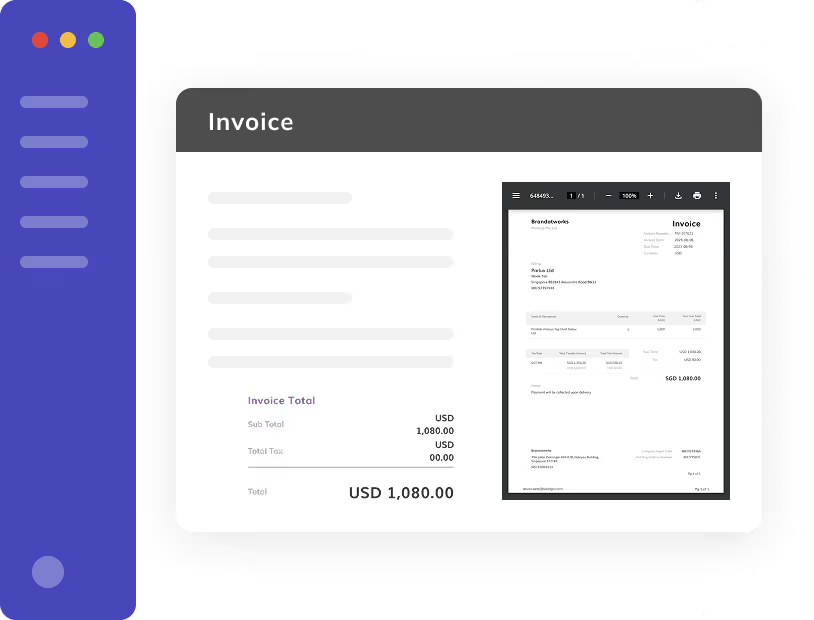
Most cloud accounting software was designed for a single business managing its own books. Eleven was designed for the firm managing books for 10, 100, or 500 businesses. That distinction shapes every feature on the platform.
Eleven is purpose-built for accounting firms and family offices.
Its multi-entity architecture allows firms to manage unlimited client entities from a single platform, switch between accounts in seconds, and generate consolidated reports without exporting to spreadsheets.
The platform supports over 100 accounting firms - including Alpadis and Mazars - and processes unlimited transactions at the Enterprise tier.
Key differentiators for firms include:
Scalable General Ledger: Unlimited transaction processing at the Enterprise tier, with no artificial caps that break workflows mid-month
AI Data Extraction: AI-powered invoice and receipt capture with 95%+ accuracy and smart GL coding that adapts to your coding patterns, fully reviewable before posting
Multi-Currency: 170+ currencies supported with full IAS 21 compliance, automated FX gain/loss calculations on every payment, and period-end revaluations - no spreadsheet workarounds
Integrated Document Management: Documents managed through an integrated DMS powered by Dokmee, keeping supporting files attached directly to transactions
Role-Based Access and Audit Logs: Every transaction carries a complete audit trail, with approval workflows and role-based access controls across all client entities
Automated AR and AP: Workflow automation for accounts receivable and payable, reducing per-client manual processing time
Custom Reporting and BI: Built-in Power BI and Excel integrations, analytical dimensions, and standardized reports across all client entities
Bank Reconciliation: Automated bank feeds with support for private banks and PDF statement extraction where direct feeds are unavailable
Real-world results from Eleven's customer base are notable. Alain Esseiva, Finance Director at Alpadis at Alpadis reported that multi-entity management saved the firm from hiring two additional staff. Camelot Trust saved 40 hours per accountant per month.
Best for: Accounting firms, CPA practices, and family offices managing 10 to 500+ client entities who need audit-ready multi-entity accounting without per-entity price penalties.
Eleven pricing
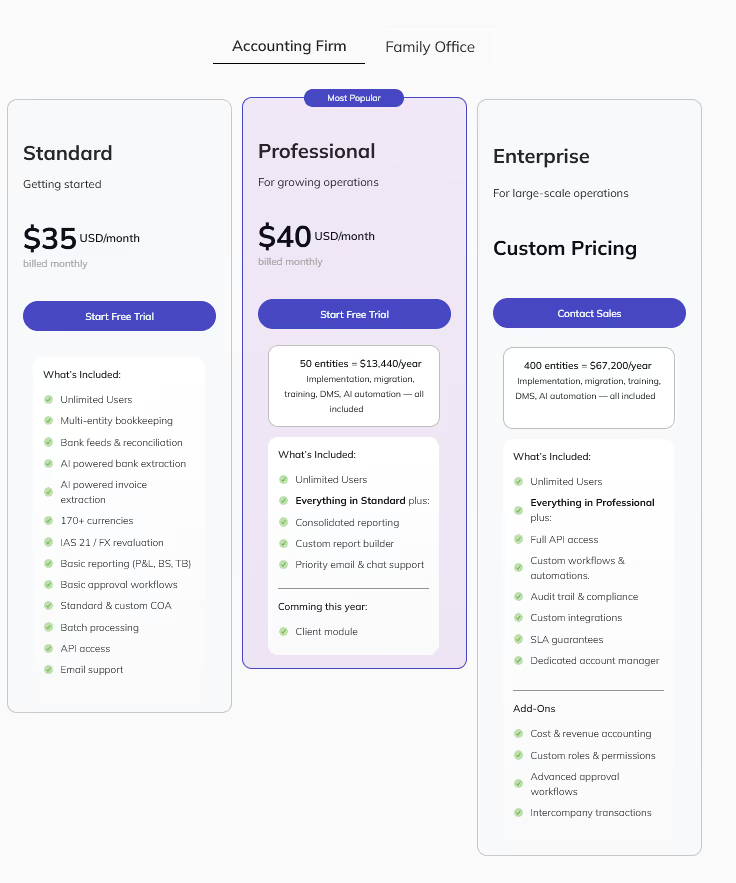
Eleven offers flexible pricing across two categories: Accounting Firms and Family Offices - with plans designed to scale with your operations.
Accounting Firms can choose from three tiers:
Standard at $35/month - ideal for getting started, with unlimited users, multi-entity bookkeeping, AI-powered tools, and 170+ currencies.
Professional at $40/month (most popular) - adds consolidated reporting, a custom report builder, and priority support. Bundles of 50 entities are available at $13,440/year, fully implemented.
Enterprise at custom pricing - built for large-scale operations with full API access, custom workflows, audit trail, SLA guarantees, and a dedicated account manager.
Family Offices have two options:
Single Family Office at $55/month - includes cost & revenue accounting, intercompany transactions, AI-powered insights, and advanced approval workflows.
Multi-Family Office at custom pricing - adds white labeling, custom integrations, and priority support for firms managing multiple families.
All plans include a free trial, and enterprise tiers require contacting the sales team for a quote.
2. Sage Intacct - Best for Mid-Market Firms Needing Advanced Financial Management
Sage Intacct is the only cloud accounting software endorsed by the American Institute of Certified Public Accountants (AICPA), which speaks to its credibility as an accounting-first platform. It is designed for mid-market companies and accounting practices that have outgrown QuickBooks but are not ready for full ERP complexity.
According to Sage's own analysis, QuickBooks cannot give finance teams a single view of shared accounts, customers, and vendors across entities - forcing manual management of intercompany eliminations, revenue recognition, and allocations. Sage Intacct addresses this with true multi-entity consolidation, automated GL coding, and AI-assisted error detection.
Sage Intacct also supports HIPAA compliance and enterprise-grade cybersecurity, making it suitable for firms serving regulated industries. Pricing is by custom quote - typical annual costs range from around $15,000 to $60,000+ depending on modules and user count.
Best for: Mid-market accounting practices and finance teams that need deep multi-entity consolidation and AICPA-endorsed controls, with budget for enterprise-tier software.
Sage pricing
Sage Intacct does not publish standard pricing. Every plan is custom-built based on your organization's size, industry, and the modules you need.
To get a quote, you'll need to request pricing directly through their sales team. Based on third-party estimates, typical annual costs range from around $15,000 to $60,000+.
3. Xero - Best for Collaborative Workflows and Third-Party Integrations
Xero has built a strong reputation among accounting practices, particularly for its unlimited-user model and extensive third-party app marketplace. Unlike QuickBooks Online, which charges per user, Xero allows an entire firm to access the platform without escalating subscription costs as headcount grows.
Xero's core features include invoicing, bank reconciliation, expense tracking, project tracking, and multi-currency support. Its marketplace of over 1,000 third-party integrations is one of the broadest in the industry.
The platform is well-suited to small accounting practices and bookkeeping firms managing SMB clients. For practices scaling into multi-entity management, Xero has limitations: it does not support consolidated reporting across multiple clients natively, and managing large numbers of client files can become operationally complex at scale.
Best for: Small to mid-size accounting practices managing SMB clients who value an extensive integration ecosystem and collaborative team access.
Xero pricing
Xero offers three plans, billed monthly:
Early - $25/month. Up to 20 invoices and 5 bills, basic cash flow forecasting, and core reporting.
Growing - $55/month. Unlimited invoices and bills, auto-reconciliation, and performance dashboards.
Established - $90/month. Everything in Growing, plus multi-currency support, project tracking, expenses, and advanced analytics.
Multi-currency is only available on the Established tier.
Note: they're currently running a promotional 85% discount for the first 6 months for new US customers (until March 31, 2026), but those are the standard prices. Multi-currency is only available on the top tier.
4. Oracle NetSuite - Best for Large Enterprises
For large enterprises and high-growth companies, Oracle NetSuite is the gold standard for cloud-based ERP. It integrates financial management with inventory, order management, CRM, HR, and supply chain in a single platform.
NetSuite handles multi-currency, multi-entity consolidation, and sophisticated revenue recognition natively.
Downsides are complexity and cost. NetSuite requires significant implementation investment, ongoing developer support for customizations, and a sales consultation to obtain pricing. It is not built for accounting firms managing client books - it is built for large enterprises managing their own operations.
Best for: High-growth and enterprise companies that need a full ERP system extending well beyond accounting into operations, HR, and supply chain.
Oracle NetSuite pricing
NetSuite does not publish fixed pricing. All plans are custom quoted through Oracle's sales team. Pricing is structured as a base platform fee ($999/month) plus per-user fees ($99–$199/user/month), with additional costs for modules like CRM, ecommerce, and multi-entity.
Implementation costs seem to range from $25,000 to $750,000+ depending on complexity. Total annual cost of ownership typically seems to fall between $100,000 and $500,000.
5. QuickBooks Online - Most Widely Used, But Not Designed for Firms
QuickBooks Online is the dominant small business accounting platform in the United States, with an extensive feature set covering invoicing, expense tracking, bank reconciliation, tax preparation, and payroll. For a single small business managing its own books, it works well.
For accounting firms managing multiple clients, the structural limitations are significant. QuickBooks Online lacks a native multi-entity view, meaning firms must operate separate instances for each client with no consolidated reporting across them. Per-entity subscription pricing also creates a cost structure that penalizes growth, and subscription costs have increased substantially since 2017.
It is the most widely adopted platform in the market - which makes it a reasonable option for firms whose clients are already using it and need basic access. It is not the right primary platform for building an efficient multi-client practice.
Best for: Small businesses managing their own single-entity books. Not recommended as the primary platform for accounting firms managing multiple client entities.
QuickBooks Online pricing
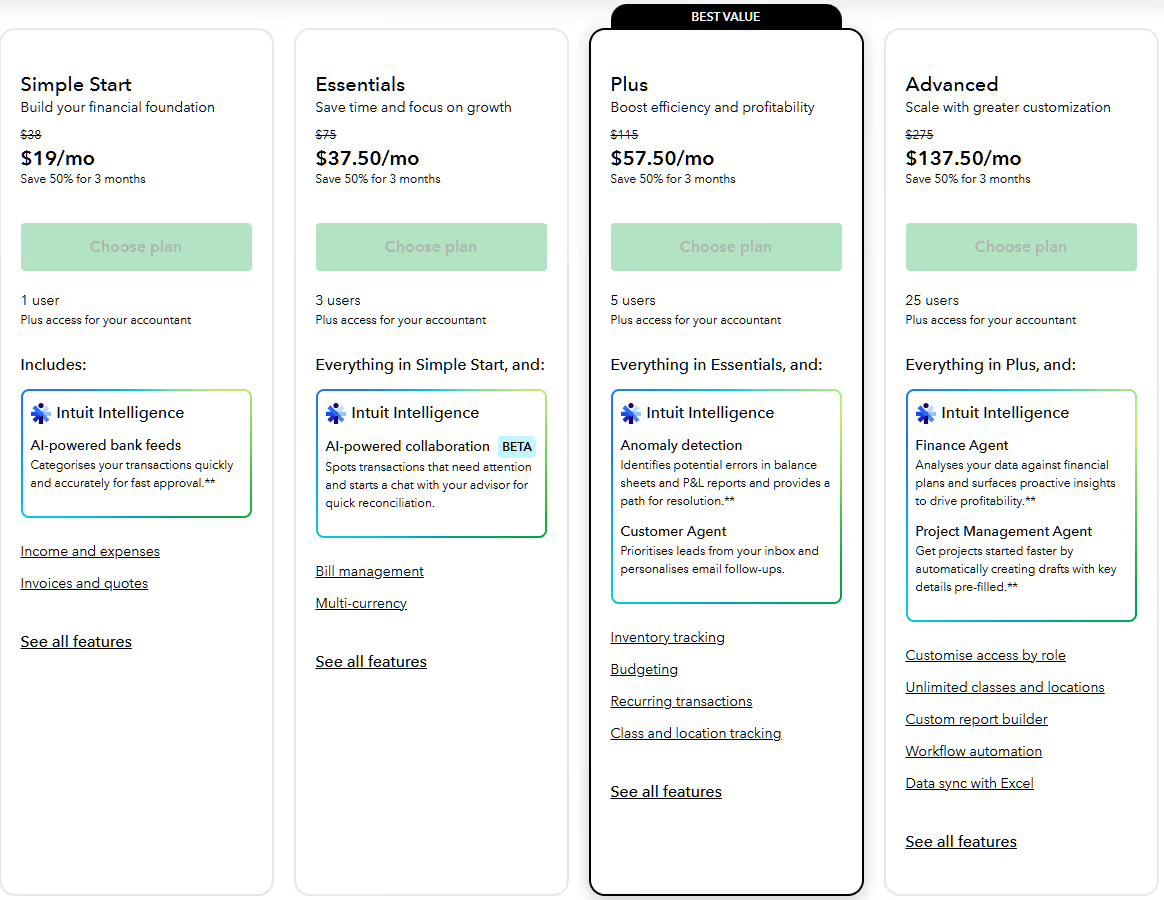
QuickBooks Online does not publish pricing on request. Plans are available directly on their website. There are five tiers, ranging from $20 to $275/month:
Solopreneur — $20/month. Basic income, expense tracking, and tax management for one-person businesses.
Simple Start — $38/month. Core accounting tools for small businesses, including invoicing and bank feeds.
Essentials — $65/month. Adds time and expense tracking, and up to 3 users.
Plus — $99/month. Adds inventory management, project tracking, and up to 5 users.
Advanced — $275/month. Up to 25 users, advanced analytics, custom workflows, and priority support.
The first 3 months are 50% off.
Each client entity requires its own subscription, which makes costs escalate quickly for firms managing multiple clients.
6. Zoho Books - Best Value for Small Businesses
Zoho Books offers an extensive accounting feature set at pricing well below QuickBooks Online, including invoicing, expense tracking, project management, multi-currency transactions, automated workflows, and an Accounting Client Portal.
For small businesses already embedded in the Zoho ecosystem - using Zoho CRM, Zoho Projects, or other Zoho products - the integration benefits are meaningful.
Best for: Small to medium businesses wanting comprehensive accounting features at a lower price point, especially those already using other Zoho products.
Zoho Books pricing
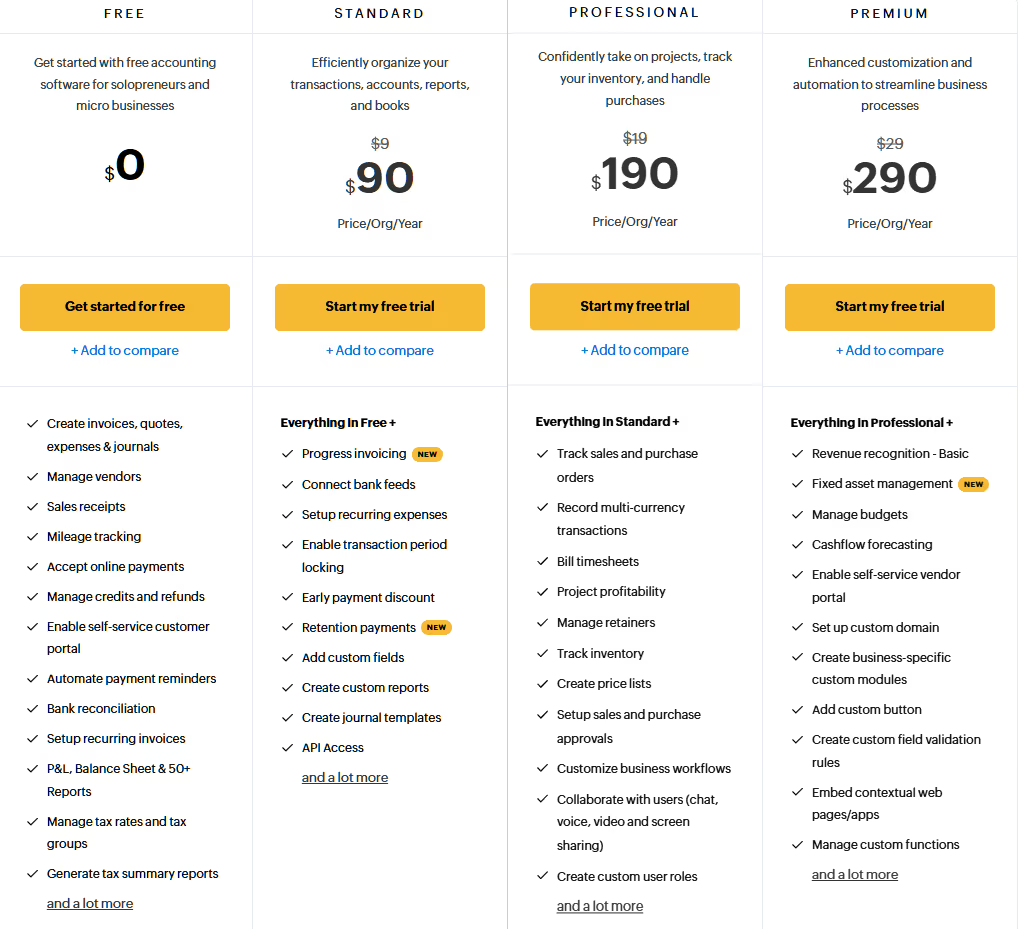
Zoho Books offers six plans, billed monthly (annual billing available at a discount):
Free — $0/month. Basic invoicing, expense tracking, bank reconciliation, and reporting. Limited to 1 user + 1 accountant, and businesses with under $50K annual revenue.
Standard — $20/month ($15/month billed annually). Adds bank feeds, recurring expenses, custom reports, and API access. Up to 3 users.
Professional — $50/month ($40/month billed annually). Adds multi-currency, purchase orders, inventory tracking, project profitability, and custom workflows. Up to 5 users.
Premium — $70/month ($60/month billed annually). Adds budget management, cash flow forecasting, fixed asset management, and custom modules. Up to 10 users.
Elite — $150/month ($120/month billed annually). Adds advanced inventory, warehouse management, and e-commerce channel integrations. Up to 10 users.
Ultimate — $275/month ($240/month billed annually). Adds advanced analytics, KPI tracking, and data visualization. Up to 15 users.
7. FreshBooks - Best for Freelancers and Service-Based Businesses
FreshBooks is purpose-built for service-based businesses, consultants, and freelancers. It strong points are time tracking, project management, invoicing, and client billing - the operational priorities of businesses that sell time, not products.
FreshBooks is the easiest cloud accounting software to use for someone without a formal accounting background, which is both a strength and a limitation. For complex accounting tasks - multi-entity consolidation, advanced reporting, audit trails - it is not the right tool.
Best for: Freelancers, sole traders, and service-based small businesses that prioritize ease of use, invoicing, and time tracking.
FreshBooks pricing
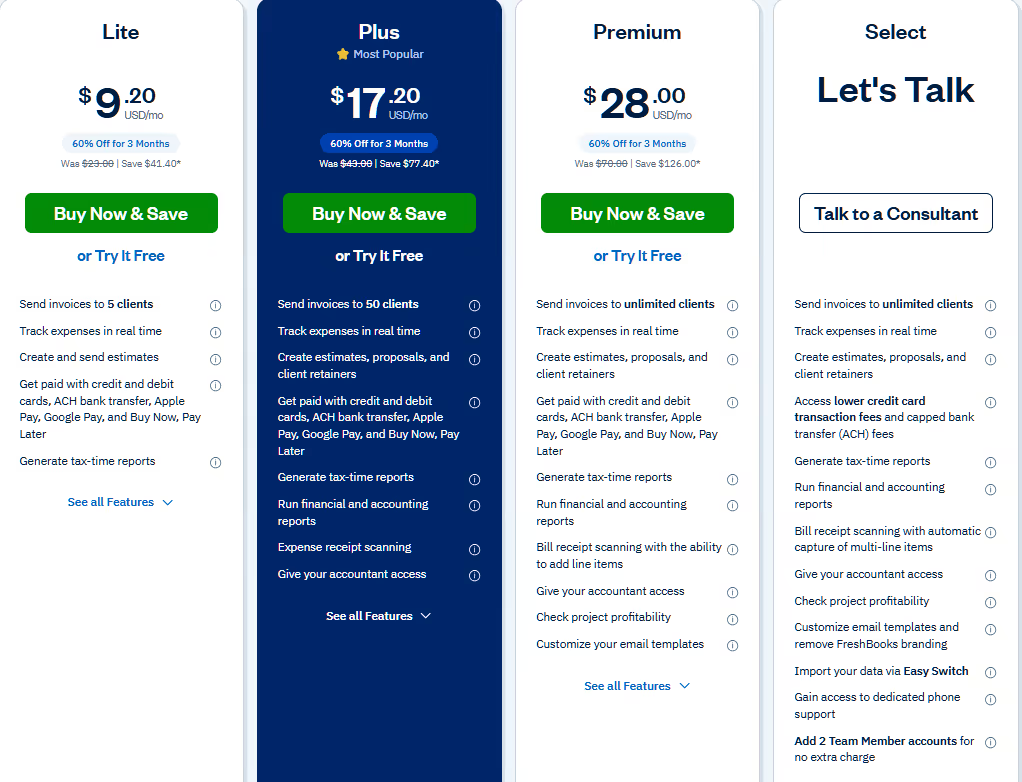
FreshBooks offers four plans, billed monthly:
Lite — $23/month. Invoicing for up to 5 clients, expense tracking, estimates, and tax-time reports.
Plus — $43/month. Up to 50 clients, adds double-entry accounting reports, bank reconciliation, proposals, client retainers, and accountant access.
Premium — $70/month. Unlimited clients, adds project profitability tracking, accounts payable, and automated bill receipt capture.
Select — custom pricing. Unlimited clients, lower transaction fees, dedicated support, onboarding services, and 2 team member accounts included.
Additional team members can be added to any plan at $11/user/month.
Quick Comparison: Which Tool Is Right for Your Firm?
Software
Best for
Multi-entity
Multi-currency
Firm pricing
Eleven
Accounting firms, CPA practices, family offices
✅ Native
✅ 170+ currencies, IAS 21
✅ Flat rate, unlimited entities (Enterprise)
Sage Intacct
Mid-market firms
✅ Yes
✅ Yes
⚠️ High - $15K-$60K+/yr
Xero
Small-mid practices, SMB clients
⚠️ Limited
✅ Yes
⚠️ Per-client subscription
NetSuite
Large enterprises
✅ Yes
✅ Yes
❌ Enterprise ERP pricing
QuickBooks Online
Single-entity SMBs
❌ No
⚠️ Limited
❌ Per-entity pricing
Zoho Books
SMBs, Zoho ecosystem
❌ No
✅ Yes
✅ Low cost
FreshBooks
Freelancers, service businesses
❌ No
⚠️ Limited
✅ Low cost
What Is the Best Cloud-Based Accounting Software?
There is no universal answer - the right platform depends entirely on who is using it and what they are managing.
For a freelancer or solo trader: FreshBooks or Wave - simple, low cost, no accounting background required
For a small business managing its own books: Zoho Books or QuickBooks Online - both offer strong SMB feature sets
For a growing business with international operations: Xero - strong multi-currency support, unlimited users, and an extensive app marketplace
For a mid-to-large enterprise: Sage Intacct or NetSuite - full multi-entity and ERP capabilities at enterprise pricing
For an accounting firm or CPA practice managing multiple client entities: Eleven - purpose-built multi-entity accounting with no per-entity fees, audit-ready controls, AI automation, and 170+ currencies
The pattern is consistent: software built for single businesses will always hit a ceiling when deployed across dozens of client entities. The accounting firms that scale most efficiently choose a platform built for the firm - not a platform built for their clients.
Try Eleven - Purpose-Built for Accounting Firms
Eleven is designed for accounting firms and CPA practices managing 10 to 500+ client entities.
It offers unlimited entities and transactions at the Enterprise tier, 170+ currency support with full IAS 21 compliance, AI-powered document capture, integrated document management, audit-ready reporting, and approval workflows - all from a single platform.
Over 100 accounting firms, including Alpadis, Mazars, and Camelot Trust, have made the switch.
Most firms fully migrate within 30 days, with white-glove support at no extra cost for Enterprise clients.






%20(1).avif)
.avif)
.avif)