SaaS Accounting in 2026: Best Strategies for SaaS Companies
SaaS accounting works differently. Learn how to handle revenue recognition, deferred revenue, and compliance the right way in 2026.
SaaS companies deliver services continuously, which means standard accounting rules often don't apply. This guide breaks down why revenue recognition is more complex, how deferred revenue affects your balance sheet, and what strategies help growing companies stay compliant and in control.
In this article
SaaS accounting isn't just bookkeeping with a subscription twist.
When revenue is earned over months, contracts shift mid-cycle, and cash flow tells a different story than recognized revenue, standard financial management logic breaks down fast.
Getting it right affects everything from investor reporting to strategic planning. This guide covers what SaaS companies need to get right in 2026.
What is SaaS Accounting?
SaaS accounting is a subsystem of financial management whereby the peculiarities of this subscription-based revenue model of SaaS businesses are catered for. Unlike traditional sales models, where revenues are recognized at points of sale, in SaaS accrual accounting only, revenues are recognized over the service period.
Cash-based accounting records income and expenses only when cash is received or paid, making it easier to maintain but less suitable for subscription-based SaaS models. This approach meets the accruals accounting method guided by specific guidelines under Generally Accepted Accounting Principles and International Financial Reporting Standards.
Some key areas covered by SaaS accounting include:
Revenue Recognition: SaaS companies must follow ASC 606 in the United States and IFRS 15 internationally, which prescribe revenue recognition as services are delivered, not at the transaction time.
Deferred Revenue: This is the liability on the Balance Sheet and is pre-receipts against services not yet rendered.
Customer Contracts: Customer contracts are generally complex. Most contracts have multiple performance obligations, specifically where recognition criteria vary.
Optimizing Revenue Management with Accounting SaaS Solutions
Revenue management is one of the biggest accounting challenges for SaaS companies. In 2026, recurring revenue, deferred revenue, subscription changes, churn, and usage-based pricing make financial reporting far more complex than in traditional business models.
This is where accounting SaaS solutions become essential. They help companies track revenue more accurately, automate key accounting workflows, and maintain better visibility into cash flow, performance, and compliance.
For SaaS businesses, strong revenue management is not just about keeping the books clean. It affects forecasting, investor reporting, strategic planning, and the ability to scale with confidence.
A SaaS accounting strategy helps companies do three things better:
→ recognize revenue correctly→ stay compliant as the business grows→ gain clearer visibility into financial performance
In a market where pricing models evolve quickly and finance operations become more complex at every stage of growth, accounting SaaS solutions give teams the structure and control they need to make better decisions.
SaaS Accounting Fundamentals
SaaS accounting is different from traditional accounting because revenue is usually earned over time, not at the moment of sale. Since SaaS companies operate on subscription models, they need accounting practices that reflect recurring revenue, contract duration, and service delivery over time.
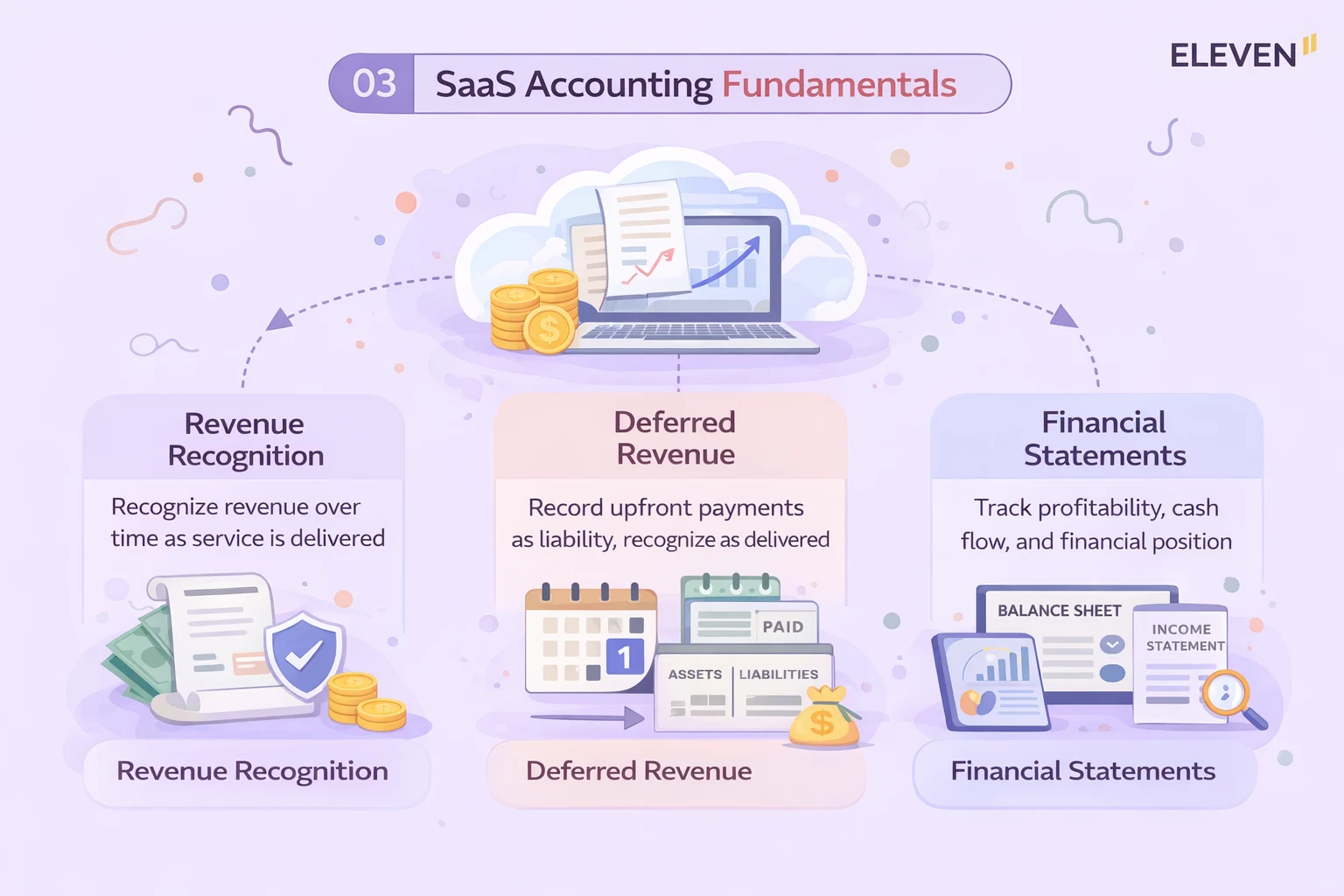
Three fundamentals matter most in SaaS accounting.
Revenue recognition
For SaaS companies, revenue cannot always be recognized when cash is received. Under accrual accounting, revenue is recognized over the period in which the service is delivered. This is essential for subscription businesses, especially when customers pay monthly, quarterly, or annually in advance.
Deferred revenue
Deferred revenue is another core concept in SaaS accounting. When a customer pays before the service has been fully delivered, that payment must first be recorded as a liability on the balance sheet. It is then recognized gradually as revenue over the life of the contract. Managing deferred revenue correctly is critical for accurate reporting and compliance.
Financial statements
Financial statements are the foundation of financial visibility in SaaS. The income statement shows profitability, the cash flow statement tracks cash movement, and the balance sheet shows the company’s financial position at a given point in time. Together, they help SaaS companies monitor performance, stay compliant, and make better financial decisions.
Differences Between Business Accounting and SaaS Accounting
SaaS accounting does not follow the same logic as traditional business accounting. The reason is simple: a SaaS company does not usually make a one-time sale. It generates revenue over time, through subscriptions, contract changes, and ongoing service delivery.
That changes several core accounting rules.
Revenue recognition
In a traditional business, revenue is often recognized when the sale is completed and the product or service is delivered.
In SaaS, revenue is recognized over the life of the subscription. Even if the customer pays upfront, the company cannot record the full amount as revenue immediately. It has to spread it over the period covered by the contract.
Deferred revenue
In traditional accounting, deferred revenue exists, but it is usually less central.
It is a core part of financial reporting. Annual or multi-month subscriptions are often paid in advance, which means the payment is first recorded as a liability, then recognized gradually as revenue over time.
Contracts and billing changes
Traditional business models usually rely on simpler transactions.
SaaS contracts are more fluid. Upgrades, downgrades, renewals, cancellations, and billing-cycle changes all affect how revenue is tracked and recognized. This makes accounting more dynamic and more complex.
Reporting and compliance
Traditional companies follow standard accounting principles, but SaaS businesses often face more complexity in practice because their model relies on recurring revenue.
They also need to report on metrics that matter specifically in SaaS, such as MRR, churn, and customer lifetime value, while staying aligned with standards like ASC 606 or IFRS 15.
Cash flow
In traditional businesses, cash received and revenue recognized often happen close together.
The two can be disconnected. A company may collect cash upfront but recognize the revenue over several months. That is why cash flow analysis and revenue tracking need to be handled with much more precision.
SaaS accounting is not just a variation of traditional accounting. It requires a different mindset, different reporting logic, and systems that can handle recurring revenue properly.
Financial Statements and SaaS Metrics
To understand SaaS financial performance, you need two things: financial statements and SaaS metrics.
Financial statements give you a clear view of the company’s overall health. The income statement shows revenue, expenses, and profitability. The cash flow statement tracks how cash moves in and out of the business, which is critical in SaaS where cash and revenue are often disconnected. The balance sheet shows assets, liabilities, and equity, and helps assess financial stability.
But in SaaS, financial statements alone are not enough.
You also need to track a few key metrics that reflect how the business actually performs over time. MRR and ARR measure recurring revenue and growth. Churn rate shows how many customers leave and directly impacts future revenue.
Taken together, these elements give a much clearer picture. Financial statements show where the company stands. SaaS metrics show where it is going.
Features of SaaS Accounting
SaaS accounting is characterized by several features that are specifically tailored to the subscription model:
Subscription Revenue Management: Handling upgrades, downgrades, cancellations, and renewals.
Complex Customer Agreements: Involves varying payment terms and conditions that can affect financial reporting.
Automated Billing and Revenue Recognition Processes: Essential for handling recurring revenue and ensuring compliance with accounting standards.
Strategies for Achieving Financial Success with SaaS Accounting
SaaS accounting has some unique challenges that require bespoke strategies to ensure the books are balanced and accurate and all statutory compliance matters are observed. Here are five essential techniques that will help SaaS companies navigate the complexities of their financial landscape toward success.
Regular Reconciliation: Reconciliation is one of the fundamental practices in SaaS accounting, wherein at the core lies confirmation that every piece of financial data coincides with the bank statements and other forms of financial records. This helps to find out any discrepancies quicker and rectify them to keep the integrity of the financial statements and data intact.
Benefits: The procedure's main advantages include enhancing financial reporting accuracy, avoiding financial misstatements, and ensuring compliance with accounting standards.
Implementation: Daily, weekly, or monthly reconciliations should be scheduled based on the volume of transactions. Accounting software provides extensive automation for reconciliations, making them more accessible.
Automate Financial Processes: This would significantly reduce the time spent on similar repetitive jobs, like invoicing and billing, including revenue recognition. Automating improves efficiency and reduces the chances of human error.
Benefits: It enhances operations efficiency by improving accuracy, giving the accounting team more time to focus on strategic activities.
Tools: Provide robust accounting software SaaS like QuickBooks Online, Xero, Eleven, or Netsuite, which offers automation capabilities of various accounting processes.
Adopt a Proactive Compliance Strategy: SaaS companies operate within a dynamic regulatory environment, which makes compliance one of the most essential elements of effective financial management. Being more proactive about compliance means keeping up with changes in accounting standards and implementing them quickly.
Benefits: It reduces the risk of non-conformity issues and related fines and guarantees that current standards present financial reports.
Implementation: Remain aware of changing standards affecting accounting practices, such as ASC 606 and IFRS 15, and consult auditors or consulting organizations that can help explore the nuances and provide further recommendations for compliance.
Keep Detailed Records: Any SaaS firm is supposed to keep detailed records of all financial transactions. The record maintained gives good audit processes and precious insights into the inner financial workings of a subscription business model.
Benefits: It facilitates audits easily, aids accurate financial reporting, and allows management to make decisions from a numerically correct viewpoint on all economic activities.
Implementation:Implement document management and accounting systems using SaaS, in which financial documents can be easily stored and retrieved.
Regular Financial Review: Financial reviews are essential to understanding a SaaS Company's financial position and health. Financial reviews provide insight into critical areas of economic performance, indicate any noticeable trends, and project how those trends will continue while planning accordingly.
Benefits: It enhances the possibility of early detection of financial problems, supports strategic planning, and ensures that the enterprise is promptly fitted to altered financial circumstances.
Implementation: Reviews are to be done monthly, quarterly, and annually. The analysis will be practical, as the accounting software will be implemented using dashboards of financial reporting tools.
Choosing the Right SaaS Accounting Services
In that respect, your investment decision has to be pivotal enough to ensure your business can meet the complicated requirements of the SaaS business model and perform well in the market. This chapter discusses factors you must observe when choosing appropriate SaaS accounting services while shedding light on the contribution of advanced tools like Eleven software to enhancing financial operations.
Understanding Your Needs
The right way to choose appropriate SaaS accounting services is to understand your business's specific needs. Consider:
Size and Scale: Your company's size and growth trajectory greatly determine the type of accounting service that will be required or used.
The complexity of Revenue Streams: Companies that multiply their services into many tiered pricing levels, permit bundled services, or serve international customers will likely require more complex accounting solutions.
Compliance Requirements: Depending on location and market, compliance requirements must be vigorously pursued through local and international standards, such as ASC 606 and IFRS 15.
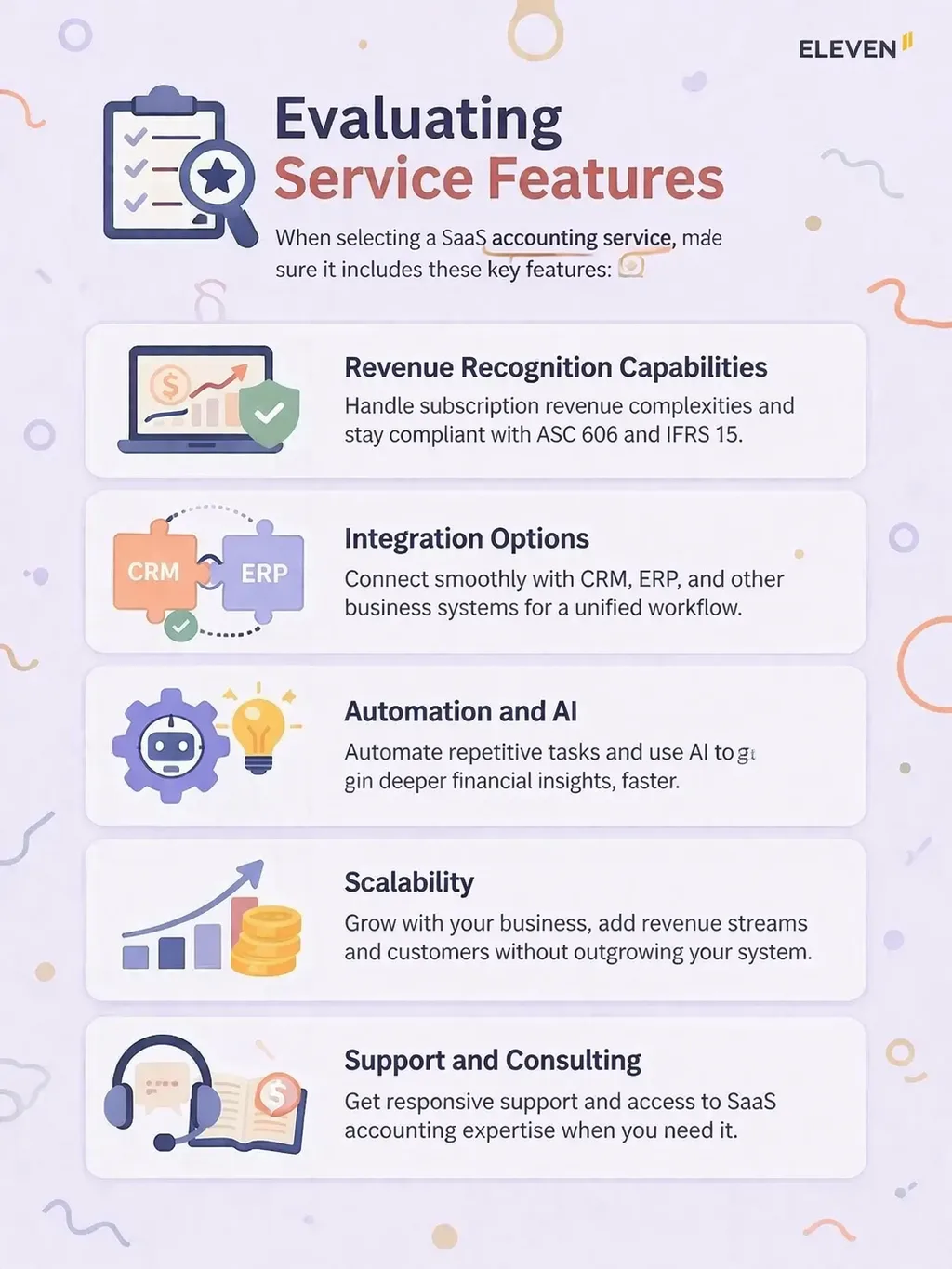
Evaluating Service Features
When you take to selecting a SaaS accounting service, deem it all-important to make sure that the chosen one at least includes the following features:
Revenue Recognition Capabilities: The service must be designed with advanced tools that manage all the complexities of subscription-based revenue recognition and keep it compliant with ASC 606 and IFRS 15.
Integration Options: The service should integrate well with other business systems, such as CRM and ERP solutions, for an integrated approach to managing business functions.
Automation and AI: These are services included in automation for doing repetitive tasks and using artificial intelligence to gain insight into finances, which helps be more efficient while preparing the accounts.
Scalability: A chosen service should fit your business and support your new revenue streams while the number of customers increases without completely overhauling the system.
Support and Consulting: Support should at least be good, having access to financial resources, particularly concerns related to SaaS accounting.
Considering Eleven Software
Eleven is one of the finest options for SaaS accounting services, particularly for innovative and comprehensive business solutions. Here are some reasons Eleven accounting software can be pegged at a higher level:
Specialized SaaS Features: Eleven is designed with SaaS companies in mind; hence, the product boasts custom features targeting the specificities that characterize subscription management and revenue recognition.
Advanced Automation: At Eleven, the latest automation technologies minimize manual accounting work and reduce errors from invoicing to financial reporting.
Comprehensive Integration: Integrating major CRM and ERP systems will ensure that financial data seamlessly flows across the respective platforms for an end-to-end view of business metrics.
Real-Time Analytics: Eleven furnishes real-time financial analytics, which affords businesses access to critical financial metrics such as MRR, ARR, and CAC in real-time. This allows agile decision-making and financial planning.
Regulatory Compliance: Eleven, with its compliance features inbuilt, ensures that your accounting practices meet the relevant standards to avoid most non-compliance-related penalties.
Scalability and Customization: A highly scalable platform that can grow with the dynamic SaaS business and is customizable based on business processes or requirements.
Making the Decision
Choosing the exemplary SaaS accounting service involves:
Assessing Potential Vendors: Conduct thorough assessments of potential vendors to ensure they meet your needs.
Requesting Demos and Trials: Request demos or trial periods to evaluate the software before committing.
Checking References and Reviews: Look at customer testimonials and third-party reviews to gauge the service's effectiveness and reliability.
Considering Costs vs. Benefits: Weigh the costs of the accounting service against the benefits it brings in terms of saved time, improved accuracy, and compliance assurance.
Conclusion
The rising number of SaaS companies and their forms puts increasing pressure on the need for appropriate accounting strategies.
The outcome will be the proper practice and tool to ensure conformity with ever-complex accounting standards and provide strategic insights to drive business decisions.
In 2026, the SaaS organization that can correctly implement this strategy would be better placed to tackle financing health by realizing marked opportunities toward sustainable growth.
Bénédicte Rivary is an SEO strategist, technical writer, and multilingual content specialist with experience across SaaS, product marketing, and localization. She has worked with companies including lemlist, Didomi, and Dropcontact, focusing on SEO strategy, technical content, and multilingual growth initiatives. At Eleven, she contributes educational content focused on accounting technology, automation, and AI-driven business operations.




.avif)