How to Implement Accounting Automation: A Practical Guide for CPA Firms and Family Offices
Learn how CPA firms and family offices can streamline financial operations by automating repetitive accounting tasks with the right tools and processes.
Accounting automation helps reduce manual work, improve accuracy, and give you real-time visibility into your finances. This guide covers what it looks like in practice, which functions to prioritize, and how to implement it step by step without disrupting your operations.
In this article
Still manually entering invoices, chasing down approvals, and reconciling accounts one row at a time?
There's a better way:
Accounting automation is no longer just for large enterprises with deep IT budgets.
Today, CPA firms and family offices of every size are using it to cut costs, reduce errors, and free up their teams for the work that actually moves the needle.
This guide walks you through everything you need to know: what accounting automation is, why it matters, and exactly how to implement it in five practical steps.
What Is Accounting Automation?
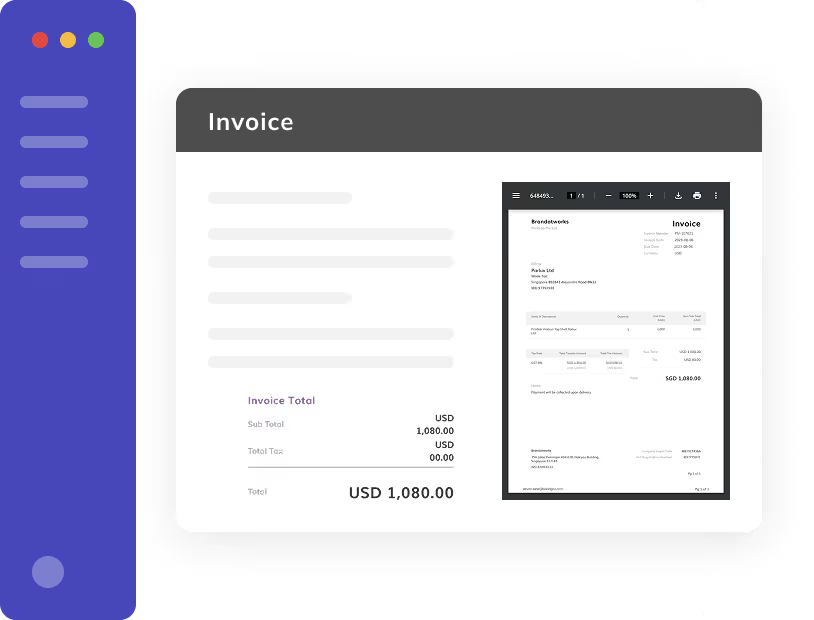
Accounting automation means using software to handle repetitive financial tasks like data entry, invoice processing, bank reconciliations, and report generation without requiring someone to do them manually every time.
Think of it as giving your accounting team a very reliable, very fast assistant that never makes a typo and works around the clock. The software connects to your existing systems, pulls in financial data, applies your rules, and keeps everything up to date automatically.
It doesn't replace your accountants. It removes the grunt work so they can focus on strategy, analysis, and decisions that actually require human judgment.
Why Manual Accounting Is Holding You Back
Manual accounting worked fine when transaction volumes were low and firms moved slowly. That's not today's world. Here's what sticking to manual processes actually costs you:
It's a breeding ground for errors: When humans key in data, errors happen. A misplaced decimal, a duplicate entry, a figure copied from the wrong column. Small mistakes that can quietly snowball into major discrepancies. And once an error is in your books, finding it is time-consuming and fixing it is expensive.
It eats up time your team doesn't have: Reconciling accounts, processing invoices, and pulling together month-end reports can eat up dozens of hours every cycle. That's time your team could spend on client advisory work, portfolio oversight, or higher-value analysis, but instead they're buried in spreadsheets.
It doesn't scale: As your client base or portfolio grows, transaction volume grows with it. With manual systems, that means hiring more people just to keep up. Automation scales with you, handling ten times the volume without ten times the headcount.
You're always looking at yesterday's numbers: Manual accounting is inherently backward-looking. Reports get compiled at month-end, by which point the data is weeks old. Automation gives you a live view of your financial position so you can make decisions based on what's happening now, not what happened last month.
Compliance becomes a liability: Financial regulations change constantly, and CPA firms and family offices are held to a high standard. Keeping manual records consistent and audit-ready is a constant challenge, and the consequences of getting it wrong can be significant. Automated systems stay current with regulatory requirements and maintain the kind of clean, consistent records that make audits far less painful.
The Real Benefits of Accounting Automation
When firms make the switch, here's what they typically see:
Faster closes: Month-end and year-end processes that used to take days can happen in hours.
Fewer errors: Automated data entry and validation dramatically reduce the risk of mistakes.
Real-time visibility: Up-to-date dashboards and reports mean you always know where you stand.
Lower costs: Less manual labor means lower operational costs, even as volume grows.
Better compliance: Automated audit trails and built-in regulatory checks reduce your exposure.
Stronger client and vendor relationships: Timely, accurate payments and reporting build trust across the board.
The bottom line: automation doesn't just make your accounting more efficient, it makes your entire operation more agile.
5 Steps to Implement Accounting Automation
Implementing automation doesn't have to be overwhelming. Follow these five steps and you'll have a solid foundation in place without disrupting day-to-day operations.
Step 1: Map Out Your Current Processes
Before you automate anything, you need to understand what you're actually doing today. Walk through every accounting workflow, invoice processing, expense approvals, payroll, reconciliations, reporting, and document how each one works.
Ask your team where the bottlenecks are. Where do things slow down? Where do errors tend to creep in? Where does work get stuck waiting for approvals? This audit will tell you exactly where automation will have the biggest impact.
Step 2: Choose the Right Software
Not all accounting automation tools are created equal. You want software that integrates with your existing systems, handles the tasks that are costing you the most time, scales as your transaction volume grows, and comes with solid support and a track record of reliability.
Don't just look at features, look at fit. A tool built for a large enterprise might be overkill for a boutique CPA firm or a family office managing a defined set of entities. Request demos, check user reviews, and ask vendors about their onboarding process.
Step 3: Roll It Out Gradually
Resist the temptation to automate everything at once. Start with the highest-impact, lowest-risk processes first, typically accounts payable, invoice processing, or bank reconciliation. Get those running smoothly, then expand to other areas.
A phased approach also gives your team time to adapt. Change management matters here. Communicate early about what's changing, why it's better, and what support is available. People are much more likely to embrace automation when they feel informed rather than surprised.
Step 4: Train Your Team Properly
The best automation software in the world won't help if your team doesn't know how to use it. Invest in proper training, not just a one-time session, but ongoing support as people get comfortable with the system.
Offer training in multiple formats: live walkthroughs, recorded videos, and written guides. Different people learn differently. As your team becomes more confident, layer in training on advanced features to help them get even more out of the system.
Step 5: Monitor, Measure, and Improve
Once you're live, the work isn't over. Set up dashboards to track key metrics like processing times, error rates, and approval cycle lengths, and review them regularly. Collect feedback from your team. If something isn't working as expected, dig in and fix it.
Accounting automation is an ongoing investment, not a one-time setup. The firms that get the most out of it are the ones that keep refining their processes as their needs evolve.
What Can You Actually Automate?
More than you might think. Here are the accounting functions most commonly and most effectively automated:
Invoice processing — capture, route, approve, and pay without manual handling
Accounts payable and receivable — manage the full payment cycle automatically
Payroll processing — calculate wages, withholdings, and generate payslips accurately
Expense management — digital capture, instant categorization, and policy enforcement
Financial reporting — generate accurate reports on demand, not just at month-end
Bank reconciliation — automatically match transactions and flag discrepancies
Tax preparation — stay compliant with up-to-date tax calculations and filing
Budgeting and forecasting — use historical data to model future financial scenarios
Asset management — track depreciation and maintenance schedules automatically
Audit preparation — maintain clean, complete records that are always audit-ready
Compliance monitoring — stay on top of regulatory changes without manual tracking
Ready to See It in Action?
Eleven is built specifically for CPA firms and family offices that are serious about getting their financial operations under control.
It integrates with your existing tools, processes transactions in real time, and scales with you as you grow, without requiring a complex implementation or a dedicated IT team.
Here's what you get with Eleven:
Seamless integration with your current accounting software, no need to rip and replace
Real-time transaction processing so your books are always current
Advanced error detection that catches mistakes before they become problems
Enterprise-grade security with encryption, access controls, and audit trails
Scalable architecture that handles growing transaction volumes without slowing down
A support team that's with you from setup through ongoing optimization
The best way to understand what Eleven can do for your firm is to try it yourself. Start your free 7-day trial today, no commitment required.
Noel Bouwmeester is an SEO content strategist and B2B SaaS writer focused on organic growth, search visibility, and AI-era content discovery. He has contributed to SEO and content marketing initiatives for companies including lempire and lemlist, helping support large-scale organic traffic growth through search-focused content strategies. At Eleven, he contributes educational SEO content focused on accounting technology, automation, and AI-driven business workflows.


.webp)
.webp)


.avif)