If you bill by the hour, realization rate tells the truth.
You may think you’re charging $200 per hour.
But what are you actually earning?
We’re here to help you answer that question:
Our free Realization Rate Calculator above shows where revenue is leaking; from write-offs, discounts, or unpaid invoices. In seconds, you’ll see your billing realization, collection rate, net realization, and effective hourly rate.
For CPA firms, family offices, and professional service teams, Realization Rate is one of the most important performance metrics you can track.
Realization rate measures how much of your potential revenue you actually turn into cash.
It answers three simple questions:
The calculator above uses four core inputs:
From these inputs, it calculates your billing realization, collection rate, net realization, effective hourly rate, and total revenue leakage.
Together, these metrics show how efficiently your firm converts time into revenue, and how much may be slipping through the cracks.
Using the tool takes less than a minute.
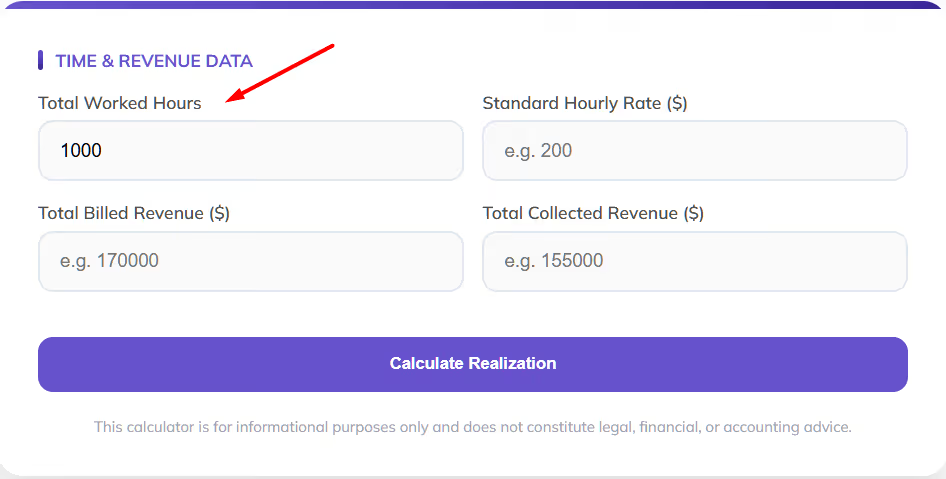
Input the total number of hours your team worked during the period you’re analyzing (month, quarter, or year).
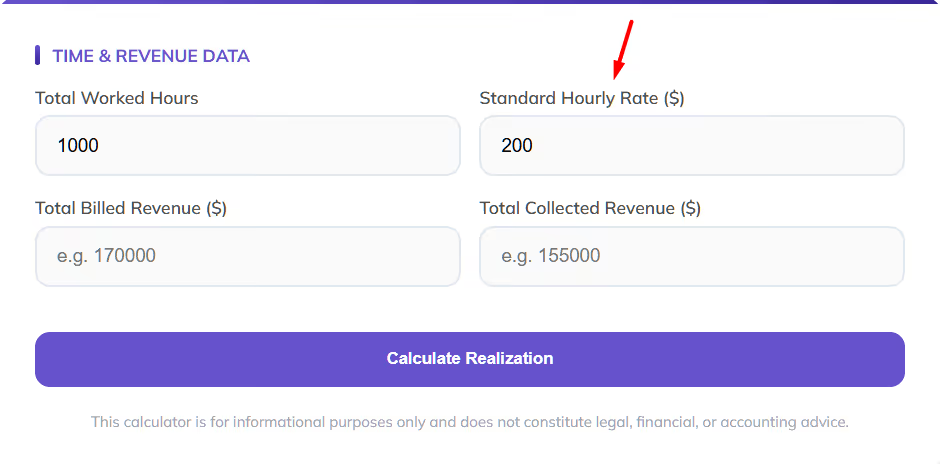
This is the rate you intend to charge.
Not discounted. Not blended. The standard rate.
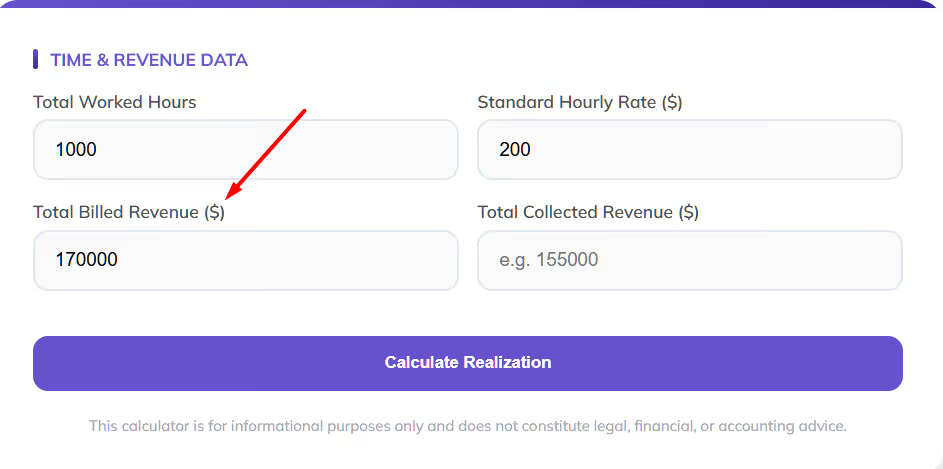
Add the total amount invoiced to clients during the same period.
Enter the actual cash received.
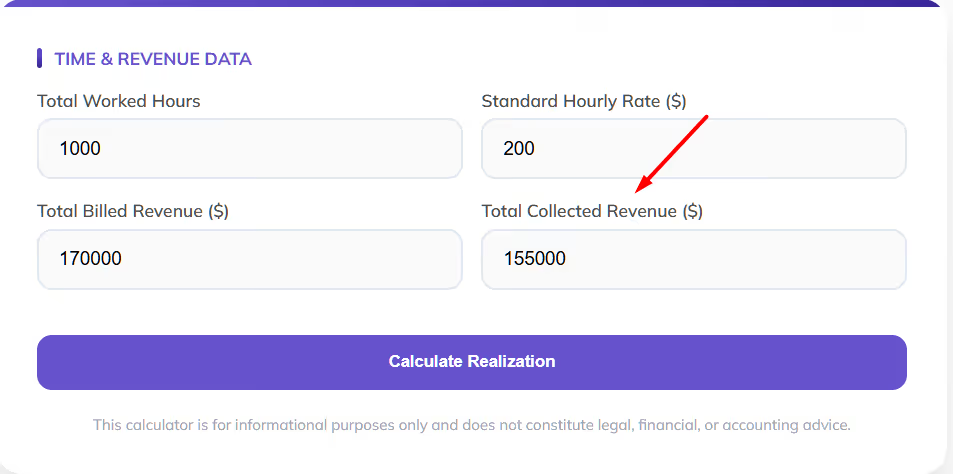
Then click “Calculate Realization.”
The tool will instantly show:
You’ll also see a performance indicator ranging from strong to significant leakage.
Because small percentage gaps hide large financial losses.
A 10–15% drop in realization can mean tens or hundreds of thousands in lost revenue. For CPA firms and family offices managing complex portfolios, even minor billing inefficiencies can significantly impact margins.
This calculator helps you:
Better realization does not require more work.
It requires tighter control.
You can calculate realization rate yourself using a few simple formulas.
Start with four numbers:
This is the revenue you could have earned.
Formula:
Total Worked Hours × Standard Hourly Rate
Example:
1,000 hours × $200 = $200,000 potential revenue
This shows how much of your potential revenue was actually invoiced.
Formula:
Total Billed Revenue ÷ Potential Revenue × 100
Example:
$170,000 ÷ $200,000 × 100 = 85%
This means 15% of work was written off or never billed. This impacts your accounts receivable turnover and overall cash flow performance.
This measures how much of what you billed was actually paid.
Formula:
Total Collected Revenue ÷ Total Billed Revenue × 100
Example:
$155,000 ÷ $170,000 × 100 = 91.2%
This is the most important number.
It shows how much of your potential revenue you actually collected.
Formula:
Total Collected Revenue ÷ Potential Revenue × 100
Example:
$155,000 ÷ $200,000 × 100 = 77.5%
This reveals what you truly earned per hour.
Formula:
Total Collected Revenue ÷ Total Worked Hours
Example:
$155,000 ÷ 1,000 = $155/hour
Even though your standard rate was $200/hour, your effective rate was $155/hour.
This shows the dollar impact of underbilling and collection gaps.
Formula:
Potential Revenue − Total Collected Revenue
Example:
$200,000 − $155,000 = $45,000 in lost revenue
You can calculate all of this manually in a spreadsheet.
But it takes time.
And small mistakes distort the results.
The free realization rate calculator above automates the entire process in seconds and shows all performance indicators instantly.
Let’s walk you through a practical example.
Assume your team worked 1,000 hours during the year, and your standard hourly rate is $200. Based on that rate, your potential revenue would be $200,000. However, you billed clients $170,000. Of that amount, you collected $155,000.
First, calculate potential revenue:
1,000 hours × $200 = $200,000
Next, compare what you billed to what you could have billed.
$170,000 divided by $200,000 gives you a billing realization of 85%. This means 15% of your potential revenue was never invoiced, likely due to write-offs, discounts, or scope adjustments.
Then, evaluate how much of your billed revenue was actually paid.
$155,000 divided by $170,000 results in a collection rate of 91.2%. While relatively strong, it still indicates some unpaid or delayed invoices.
Now look at the full picture.
$155,000 divided by $200,000 gives you a net realization of 77.5%. This is the most important number because it reflects how much of your total potential revenue you ultimately converted into cash.
Finally, calculate your effective hourly rate.
$155,000 divided by 1,000 hours equals $155 per hour.
You may think you charge $200 per hour. In reality, you earned $155 (!) per hour.
The total revenue leakage in this example is $45,000. That is the difference between what you could have earned and what you actually collected.
Over a year, that gap can significantly impact profitability. Over several years, it can reshape the financial trajectory of a firm.
Most firms lose revenue in three places:
Work performed but never invoiced.
Invoices reduced before sending.
Invoices sent but never fully paid.
Tracking realization consistently gives you visibility.
Without visibility, leakage becomes normal.
Want to reduce manual errors and speed up invoicing and collections?
See how Eleven automates AP/AR data entry with AI:
Monthly is ideal.
Quarterly at minimum.
But annual reviews are too late. By then, the leakage is already built into your margins.
Firms that monitor realization regularly tend to:
For many professional service firms, net realization above 90% is strong. 75–90% indicates moderate leakage. Below 75% suggests significant revenue loss. Targets vary depending on pricing structure and client mix.
Net realization gives the full picture.
Yes. It is especially useful for CPA firms tracking billable hours and write-offs.
Yes. Family offices managing advisory services, reporting, or billable support functions can use it to measure efficiency and collection discipline.
No. It provides a quick diagnostic snapshot. For ongoing tracking, integrated billing and accounting systems provide deeper control.
The calculator gives you visibility.
Eleven helps you improve what’s behind the numbers.
Eleven is online accounting software designed especially for CPA firms and family offices. It combines automated bookkeeping, multi-entity accounting, and financial control in one secure cloud platform.
With Eleven, you can:
Instead of reviewing realization only after the fact, you gain structured accounting workflows by learning how to automate your accounting process.
Less manual tracking. More operational clarity.
If you want more than a one-time calculation, try Eleven.
👉 Start your free trial: https://www.runeleven.com/test-drive