


.avif)
Choosing Between Cloud & Desktop Accounting Software in 2023
Planning to revamp your accounting firm's tech stack? Let's compare cloud vs desktop solutions, so you can choose the best tool and upgrade your practice.


A clear breakdown of cloud accounting pricing models, hidden costs, and how firms can choose the right setup as they grow.
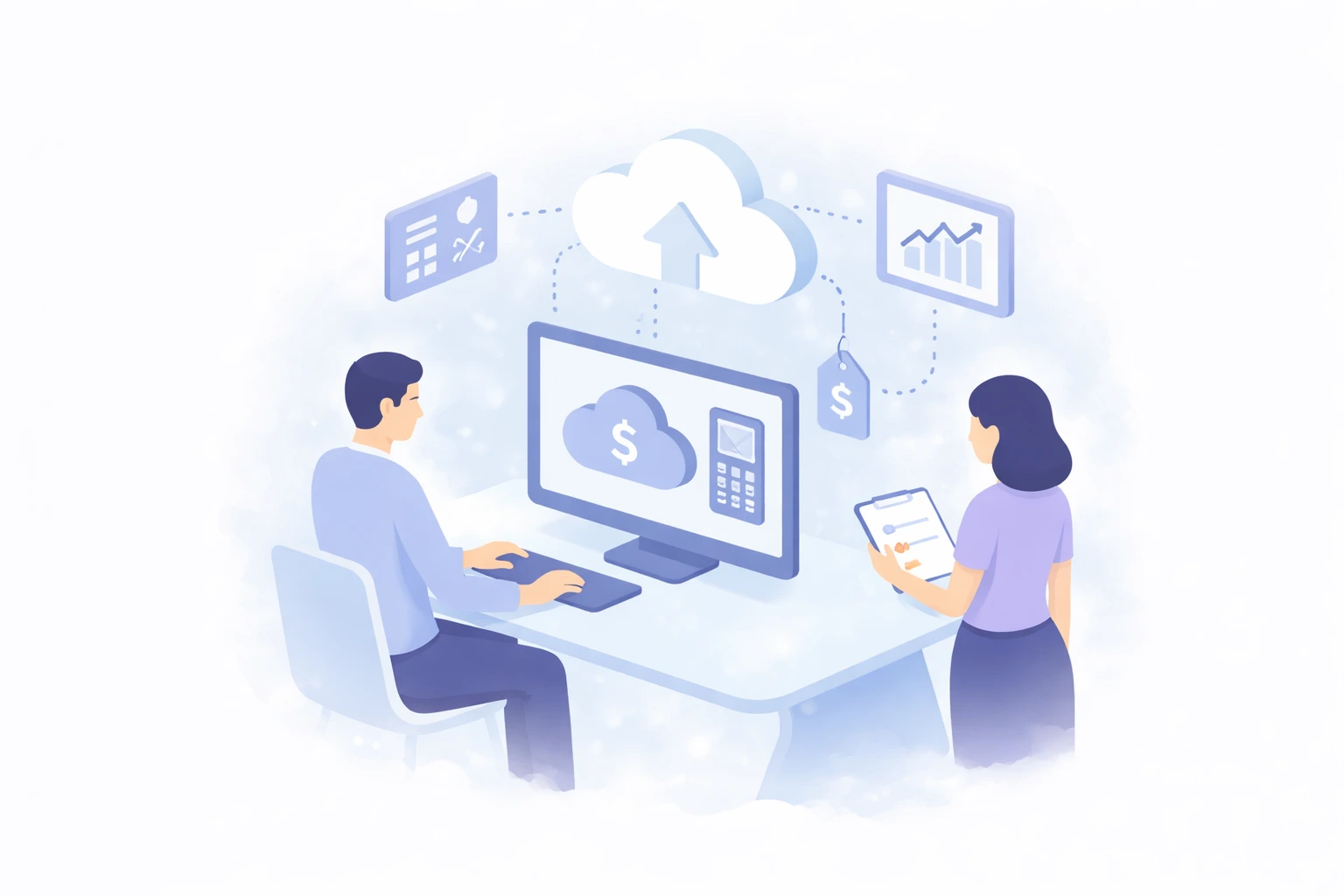
Cloud accounting pricing may seem simple, but costs can rise quickly. This guide highlights common pricing models, hidden fees, and how firms can choose a setup that scales with growth.
In this article
Cloud Accounting Software Pricing can quietly erode your margins as you grow.
Two platforms may look similar upfront, but their pricing models diverge fast once you scale. What works at 10 entities can become a cost burden at 50 or 100.
For accounting firms and family offices, pricing is not a detail. It directly impacts growth, efficiency, and long-term profitability.
This guide breaks down how cloud accounting software pricing works, what to watch out for, and how platforms like Eleven approach pricing for multi-entity environments.
Most pricing guides focus on small business tools like QuickBooks or Xero. These platforms are designed for single-entity businesses with relatively straightforward needs.
That works well until it doesn’t.
For accounting firms managing dozens of clients, or family offices overseeing complex multi-entity portfolios, those same tools and pricing models start to break down.
What looks simple at first becomes restrictive as operations scale.
At a high level, cloud accounting software pricing tends to follow a few common structures. The problem is not the models themselves, but how they behave as complexity increases.
Per-user pricing is common among general-purpose tools. It scales reasonably well as teams grow.
But it says nothing about how many entities you can manage. A firm can quickly run into operational limits without seeing it reflected in pricing.
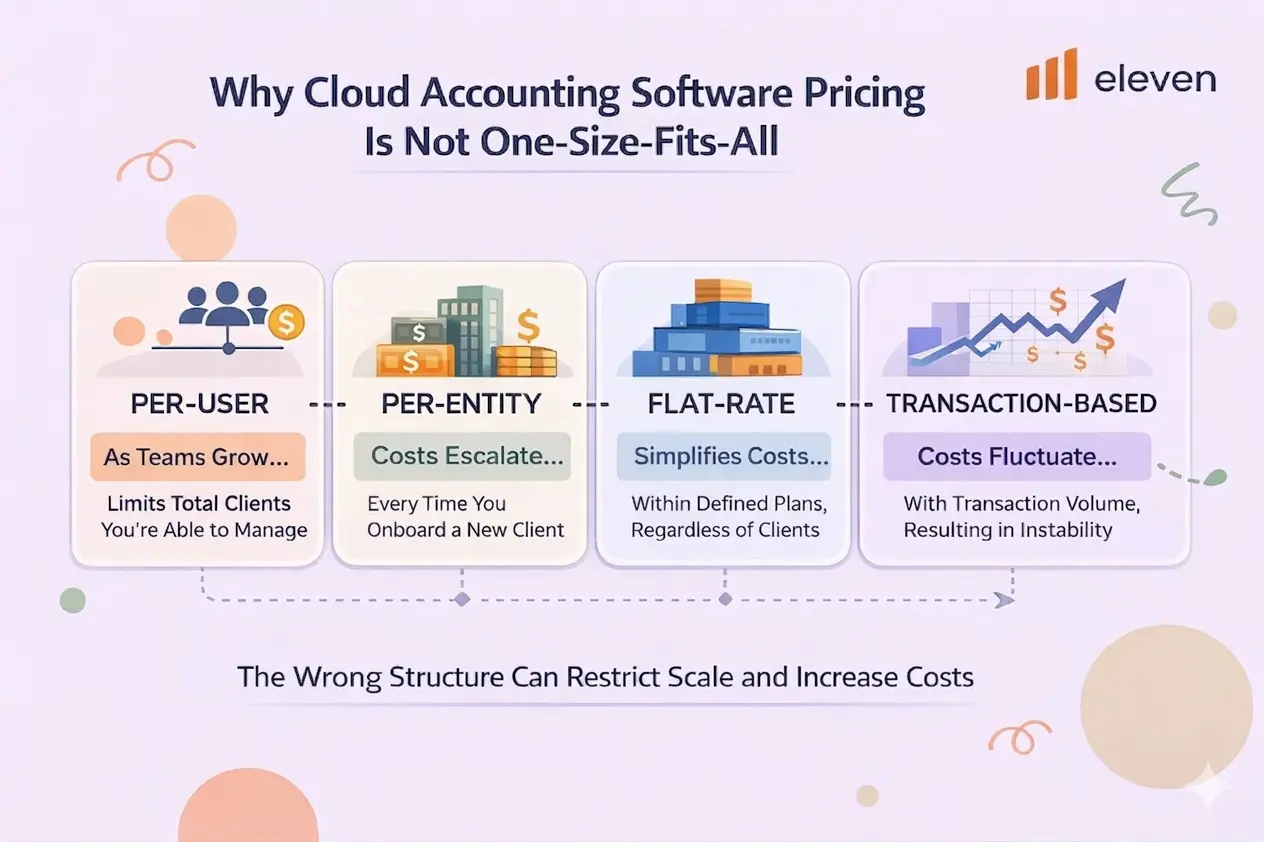
Per-entity pricing creates a more direct issue. Costs increase every time a new client or company is added.
On the surface, this feels logical. In practice, it penalizes growth.
As firms onboard more clients, software costs rise in lockstep, often without delivering additional value.
Tiered or flat-rate pricing offers a different approach. Costs are fixed within a defined plan, regardless of how many entities or transactions you handle.
For firms that are scaling, this creates predictability and removes the constant need to reassess pricing.
Transaction-based pricing introduces another layer of complexity. Costs scale with activity, not just structure.
For high-volume firms or family offices with active portfolios, this can quickly become unpredictable, especially during periods of increased activity.
In isolation, each model can make sense.
But in practice, the wrong structure can quietly limit growth, introduce cost volatility, or create operational friction over time.
CPA firms and accounting practices have specific needs that generic pricing structures rarely address. Pricing should be evaluated based on how well a platform supports scale, not just its entry-level cost.
Here are the key areas to focus on:
Family offices operate differently from CPA firms, but face similar challenges: multi-entity management, complex currency exposure, and strict documentation requirements. Pricing should reflect that complexity.
Here are the key areas to evaluate:
To make this all easier to evaluate, here’s a quick breakdown of what to look for and where pricing models often fall short:
Eleven is an accounting platform purpose-built for accounting firms and family offices managing multiple client entities. Unlike generic SMB tools, Eleven's pricing is structured to support scale without penalizing growth. Here is a full breakdown of available plans.
Standard — $35/month (billed monthly)
The entry point for firms getting started with centralized accounting. Included features:
Professional — $40/month (billed monthly) — Most Popular
Built for growing operations. Includes everything in Standard, plus:
At 50 entities, the all-in cost including implementation, migration, training, DMS, and AI automation is $13,440/year.
Enterprise — Custom Pricing
Designed for large-scale operations. Includes everything in Professional, plus:
Available add-ons at Enterprise: cost and revenue accounting, custom roles and permissions, advanced approval workflows, and intercompany transactions.
At 400 entities, the all-in cost including implementation, migration, training, DMS, and AI automation is $67,200/year.
Single Family Office — $55/month (billed monthly) — Most Popular
For one family managing their entities. Included features:
Multi-Family Office — Custom Pricing
For firms managing multiple families. Includes everything in Single Family Office, plus:
All plans include a free trial with no commitment required. Implementation, migration, training, DMS, and AI automation are bundled into the Professional and Enterprise tiers, removing the hidden costs that inflate the true price of competing platforms.
Ready to see it in practice? Start your free trial of Eleven and explore the platform with your own data, no commitment required.
Even experienced finance professionals can underestimate the total cost of ownership when evaluating cloud accounting software. This is especially true when pricing structures appear straightforward on the surface.
One of the most common mistakes is choosing a per-entity pricing model without modeling future growth. A firm adding 15–20 clients per year can see software costs escalate quickly.
Often, this only becomes visible once margins start to compress.
Another frequent issue is overlooking transaction limits. Many platforms impose caps that only show up during high-volume periods.
This can lead to unexpected disruptions or force mid-cycle upgrades, hurting both cost predictability and operational continuity.
Migration is often treated as an afterthought. In reality, moving data from legacy systems or other platforms can take weeks.
If not included upfront, it can also involve significant consulting fees.
Integration costs are another hidden factor. Platforms that seem cost-effective at first often require paid modules for essentials like bank feeds, multi-currency accounting, or document management.
Over time, these add-ons inflate the true monthly cost well beyond the advertised base price.
Finally, firms sometimes assume general-purpose tools are sufficient. This usually holds—until operations scale.
That’s when limitations in approval workflows, audit trails, and consolidation capabilities start to surface.
Before requesting a proposal from any vendor, work through these questions:
For accounting firms and family offices, the pricing model is as important as the feature set. Per-entity and per-transaction structures penalize growth. Flat-rate tiers do not.
Eleven is built for practices that need to scale, with transparent pricing, no entity caps at Enterprise, and implementation costs bundled in rather than bolted on.
Start your free trial of Eleven today and see how purpose-built accounting software can support your firm's next stage of growth.
Related content


We are using cookies. Learn more.

%20(1).avif)
.avif)


